Why OT Saints Were Rich
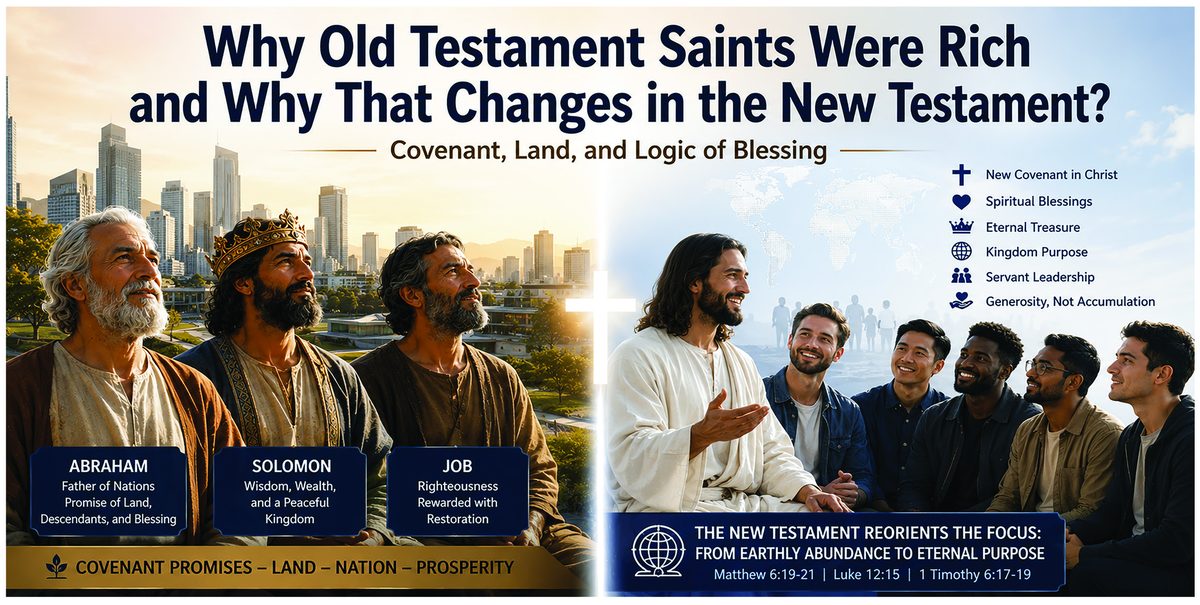
In the previous article, we raised a basic question: Is God against wealth? We have come to know that Scripture is against the sin of prosperity without responsibility and against the sin of poverty. Wealth is neither inherently good nor bad unless it is understood how it is acquired and how it is used before God in a certain manner.
Another important question is: If wealth is not the ultimate measure of God’s favor, why do so many Old Testament saints appear remarkably wealthy?
A Question from Life Experience: Recently, a young software engineer from Hyderabad: “When I read about Abraham, Job, and Solomon, it appears that God chose rich people. But whenever I listen to Jesus, I am wavy to desire to become wealthy,”.
His question is not a one-off mistake. Christian people from all walks of life are experiencing major economic shifts. Some farm families are moving into salaried jobs. Some are planning Gulf migration. Some rely on government jobs, overseas remittances, small businesses, or fast-growing opportunities in the technology field. With these new opportunities come new questions:
Is financial growth a sign of God’s blessing? Should Christians pursue prosperity? Why did many Old Testa
M. Th., Ph. D.
ment biblical saints seem to be wealthy, and was Jesus so heated in warning against wealth? Why does the Bible seem to change its mind about wealth?
We read about Abraham, Job, David, and Solomon in great wealth, but when we read about Jesus and the Apostles, we find warnings about rich people, suffering discipleship, and often churches that lived in hardship. Has God changed His attitude toward wealth? The answer is no.
These questions cannot be answered with slogans. These are questions that must be answered by understanding the larger story of the Bible. The problem is not wealth. What has changed is not God’s character, but the stage of His redemptive plan. To understand why there is so much wealth in the O.T, and why the N.T speaks differently, we need to better understand covenant, land, kingdom, Christ, and the end goal of God’s blessing. In other words what is the meaning of blessings, the purpose of God’s gifts, and in the end, where Christ sits in His redemptive plan.
1. What Does the Bible Mean by Blessing?
One of the biggest sins that Christians suffer is the assumption that blessing means prosperity. Many Christians, when they hear the word “blessing,” think of: Paychecks / Bonuses / New houses / Successful careers / Financial security.
But the Scriptures have a much larger definition of blessing. The Old Tes tament definition of blessing includes: God’s presence / Covenant relationship / Fruitfulness / Peace / Security / Justice / Land / Family continuity.
Though material wealth is one expression of blessing, it is never all of blessing. Some of the most blessed people in the Scriptures experience hardships, uncertainties, and sufferings.
The Hebrew covenant blessing included a bountiful harvest, a growing family, peace in the land, and a people’s willingness to worship. So, without first realizing that biblical blessing is living under God’s rule of grace, we cannot even ask whether God truly blessed people with wealth. Hence, Blessing is not primarily about a person’s possessions. Blessing is about living under the favor and purposes of God.
2. Why is blessing more visible in ancient Israel
This is the key to understanding the Old Testament. Israel was not merely a religious community. It was a covenant nation living in a covenant land following covenant law. So, because Israel’s life was national, agricultural, and territorial, God’s blessings largely became visible. So, when Israel walked faithfully: The rain fell / The crops grew / The herds multiplied / The enemies were held back / The families had prospered; The covenant blessings of Deuteronomy 28 were gloriously public and visible.
God wanted Israel’s country and people to be an example of what is a life under following God would look like before the nations. It does not require that every faithful Israelite become rich. Indeed, many prophets, widows, Levites, or ordinary Israelites lived in a state of sufficiency. But as a covenant people, Israel’s flourishing should be made visible. So, the Old Testament emphasis on prosperity must be understood in its “covenant” context.
3. Abraham: Blessed to Be a Blessing
The story starts with Abraham. God’s promise was never “I will make you rich.” It was “I will bless you … and in you all the families of the earth shall be blessed” (Genesis 12:2–3). Direction matters. The promise was never to end with Abraham. The promise was to flow through him. A principle runs through Scripture; God blesses His people not for possession but for participation in His purposes.
This principle is the basis for biblical economics. God’s gifts are never to end with the recipient. They’re to flow along. Abraham’s livestock, servants, silver, gold, and land are not trophies of spiritual success. They’re gifts God entrusts to him in the context of His covenant mission. Blessing is never just possession. Abraham’s wealth was His blessing, and it’s for God’s purpose. He did not possess the ability to hold.
4. Land: The Economy of Covenant Living
Land was the center of Israel’s economy. It provided: Food / Security / Identity / Inheritance / Stability. Still, the Lord kept saying, “The land is mine” (Leviticus 25:23).
What a revolution! Israel never truly owned the land. In other words, the landowner was not the owner – the landowner was a tenant. The land could be used, cultivated, and inherited. But it could never be owned absolutely. There was an economy of stewardship, not of ownership. There was stewardship and covenant accountability. Wealth was always limited by covenant accountability. God blessed His people, but He did not allow indefinite accumulation.
Wealth Under Covenant Accountability: The Old Testament never exercises an economy of abundance. Prosperity was always under covenant accountability.
Gleaning Laws (Leviticus 19:9-10): Landowners had to leave portions of their fields for: Widows / Foreigners / The poor. This was not charity. This was the law.
Debt Release (Deuteronomy 15): Every seventh year, debts were cancelled. The Lord did not want any family to be in economic bondage.
Jubilee (Leviticus 25): Every fiftieth year, land returned to the original families.
This was not about equality. This was about preventing socioeconomic dynasties. The Lord blessed people. But He protected His people from permanent oppression. The lesson is that there can be wealth, but there can never be accumulation.
5. Wisdom, Work, and Wealth
The Old Testament is practical. Proverbs says that hard work, planning, and discipline produce wealth or at least prosperity, “Diligence fattens a man” (Proverbs 10: 4). Hard work matters. Wise choices matter. Students studying diligently matter. Skill acquisition matters. The Bible never criticizes favourable economics. But Proverbs never promises automatic profit. That is where Job enters.
6. Job: Prosperity is Not the Proof of God’s Beneficence
Job tears the simple formulas. Job was a truly good man. But he lost wealth, health, fortune, family, and rank. His friends concluded that he had to suffer the punishment for his sin. God rejects their line of thought. Job teaches us a profound truth: God’s benevolence cannot simply be equated with man’s economic status. God is faithful even when prosperity is lost.
Someone who truly believes in God can be favourable. Someone who truly believes in God can also be in pain. One mustn’t equate poverty or prosperity with God’s favour. One can easily misinterpret Abraham without Job. Job guards us against summarizing God’s benevolence as a mere economic condition. This is particularly relevant where any illness, unemployment, a field failure, debt, or a family crisis is equated with loss of God’s favor. Job refuses to settle for these simplistic correlations.
7. Solomon: When Wealth Turns Spiritual Evil
Abraham teaches that wealth can be for good. Solomon warns that wealth can be spiritually dangerous. Solomon got God-given gifts: Wisdom / Peace / Influence, Prosperity. In time, prosperity turned to accumulation. Accumulation became excess. Excess became compromise. The Judean king, who used to live as a servant, more and more looked like his neighboring nations.
Solomon’s warning is for all of us today. Wealth can be a blessing of God. But wealth can also be a substitute for dependence on God. Economic success is the temptation for many modern Christians. The danger is not that we have economic success. The danger is that we allow economic success to override our trust in God.
8. The prophets: Prosperity and injustice is a covenant failure
The prophets criticized the economic life of Israel. Amos spoke out against exploitation (Amos 5:11). Isaiah spoke out against land monopolies (Isaiah 5:8). Micah exposed the corruption underlying his community’s religious life (Micah 2:1-11 and 3:1-12). The prophets remind us that stewardship is never just a personal issue. Economic systems also matter. Wages, opportunities, fairness, inclusion, exclusion, exploitation— these spiritual issues are also economic questions. The Bible demands public righteousness as well as private generosity. We recognize the prophets have been there and show us that prosperity without fairness is no blessing from God; it is an offense against God.
9. Christ: The True Blessed One and Heir of the Covenant
The greatest revolution takes place in Christ. The promises made to Abraham are fulfilled in Jesus. In Christ we find: The real Son of Abraham / The real Israelite / The real heir of the covenant / The real man blessed / The center of blessing has shifted.
The question is no longer: “Do I possess Abraham’s wealth?” The question becomes: “Do I belong to Abraham’s promised Seed?” The greatest blessing is being a participant in Christ Himself. All else flows from that foundation.
Why Jesus Preaches So Strongly About Wealth: This helps explain Jesus’ prophecies warning. Jesus never says that wealth is evil. But He repeatedly warns that wealth may adopt the man who has it as a rival God. Money tricks us with illusory stories: Of control / Of independence / Of security. The rich fool trusted his barns (Luke 12:13- 21). The rich man ignored Lazarus (Luke 16:19-31). The rich young ruler could not part with his riches (Mark 10:21). The Laodicean church confused prosperity for spiritual health (Revelation 3:14-22). Jesus is not anti-wealth. But He is deeply concerned that wealth might capture the heart of a man.
The Cross Reinterprets Blessing: The Cross changes everything. Jesus is God’s darling. But His way leads through rejection, suffering, humiliation, and unparalleled shame. This means that Christians can never define blessing in terms of outward properties of prosperity. In Calvary, we see that suffering and grace go hand in hand. We see that self-sacrifice is more important than self-promotion. We see that faithfulness is more significant than accumulation. Every Christian conception of wealth must go through the Cross before it can be sold in the marketplace.
From the Land to the New Creation: The New Testament does not give up on the theme of the land promise. It even widens the horizon. Paul says that Abraham will not receive the blessing of just one land, but will receive “the world” (Romans 4:13). Hebrews mentions a “better country” and a heavenly city (Hebrews 11:13-16). Jesus himself says: “Blessed are the meek, for they will inherit the earth” (Matthew 5:5).
The shift is startling: Canaan → The World → New Creation. What had started as a promise in one land becomes a promise in all creation. The inheritance is getting larger, not smaller.
10. Participatory Stewardship: A Biblical Concept
Here we get to the crux of this series. Participatory stewardship is the use of everything God has entrusted, money, skills, influence, education, opportunities, land, relationships and time, in participation with God’s purposes of worship, justice, compassion, discipleship and human flourishing. Stewardship is not just management of what we have. It is participation in God’s mission.
11. The Church as an Economic Community
That is why stewardship is never just individual. The church shared from resources so that “there was not a needy person among them” (Acts 4:34). The church became an economic community. Believers supported widows, served the poor, funded missions, shared burdens, and practiced generosity. The church was more than a gathering of individual stewards. It was a stewarding community. That is still a challenge for many modern churches where financial matters are still a private one.
What This Means for Christians Today: You may be a farmer, a teacher, a civil servant, an overseas or Gulf worker, a business owner, or an IT professional; the basic question remains the same. God does not first ask: “How much do you have?”. He asks: “What are you doing with all you have received?”
The biblical vision is neither prosperity without responsibility nor poverty without hope. It is participatory stewardship under the lordship of Christ.
Conclusion: From Possessing Blessing to Participating in Christ
The Old Testament optimistically illustrates prosperity because Israel participated in covenant blessings visibly before the nations. The New Testament does not curse these blessings. Christ ennobles and renews them. The focus likely shifts from visible covenant prosperity to participating in the crucified and risen Lord, who has all weapons in His hand. The richest blessing is not what we possess. It belongs to Christ and participates in His Kingdom.
Final Reflection: Abraham reminds us that blessing is for mission; Job reminds us that blessing is not prosperity; Solomon reminds us that prosperity can be an idol; the prophets remind us that wealth without justice is treacherous; the Cross reminds us that God’s favor is not bad for suffering; the Church reminds us that stewardship is communal; and Christ reminds us that the richest blessing is not what we possess, but whom we belong to.
Rev. Dr. Dola Vijay Kumar , a New Testament scholar, serves as Assistant Pastor at Santhosh Nagar Lutheran Church and is a former entrepreneur.