Steady Lives in a Shaking World

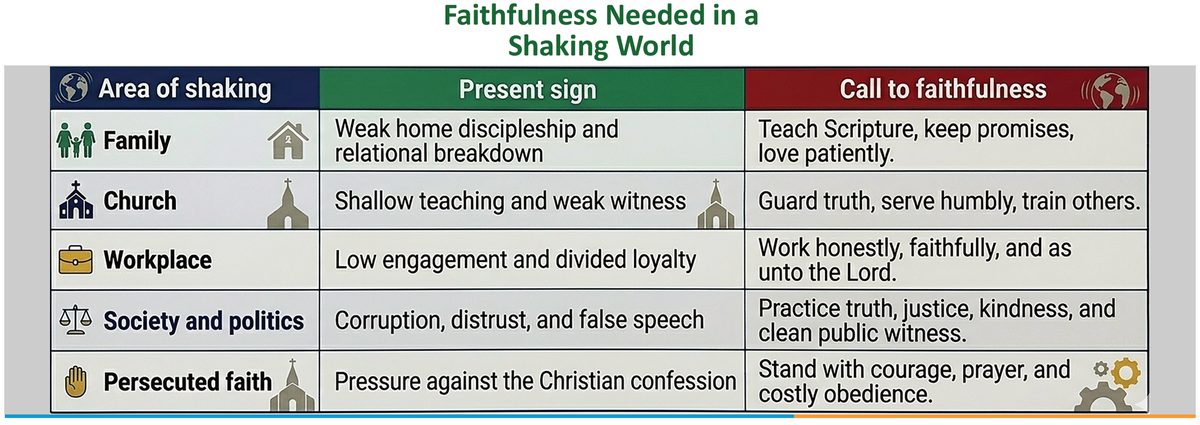
Our world is shaking in many places at once: families are under strain, public life often loses truth, religion can become shallow or violent, workplaces suffer from low trust and low commitment, and churches face weak discipleship. In such a time, the Church does not merely need gifted people. It needs faithful people. Gifts may open doors, but faithfulness carries responsibility without shame.
Recent reports show why this theme is urgent. The American Bible Society’s State of the Bible 2024 says Gen Z adults were the least Scripture-engaged group in its study. Pew reports serious religious switching, Gallup reports weak workplace engagement, Transparency International reports continuing corruption, and Open Doors reports heavy pressure on persecuted Christians. These reports point to one shared burden: the Church needs deeper Scripture, stronger homes, faithful youth, steady leaders, clear doctrine, courageous witness, and ser vants who will not run away when the road becomes hard.
The Meaning, Nature, and Theology of Faithfulness
“Great is thy faithfulness” (Lamentations 3:23) . Faithfulness means being true, steady, loyal, trustworthy, and dependable. A faithful person keeps promises, carries duty, guards truth, and remains loyal even when the cost is high. Faithfulness is not a passing feeling. It is a settled life. In simple words, faithfulness is love that stays, truth that stands, duty that serves, and faith that does not run away.
In the Old Testament, the Hebrew word emunah carries the idea of firmness, steadiness, reliability, and truth. In the New Testament, pistos means faithful, trustworthy, reliable, or believing, while pistis may mean faith, trust, belief, or faithfulness. W. E. Vine explains “faithful” as one who can be trusted. BDAG gives the sense of being worthy of belief or trust. John Calvin said true doctrine is “not a matter of the tongue, but of life.”
The theology of faithfulness begins with God Himself. God does not merely command faithfulness; He is faithful. “God is faithful” (1 Cor. 1:9). “Faithful is he that calleth you” (1 Thess. 5:24). Jesus Christ is called “Faithful and True” (Rev. 19:11). The Holy Spirit produces faithfulness as fruit in believers (Gal. 5:22). Therefore, Christian faithfulness is our answer to God’s own faithfulness. We remain because He holds us. We serve because He first loved us. We endure because His grace is stronger than our fear.
The nature of faithfulness includes truthfulness, stability, obedience, patience, sacrifice, purity, accountability, and perseverance. A faithful person is steady in secret, not only impressive in public. He is faithful to God, family, Church, work, and society.
Timothy: A Steady Life Formed Before It Was Seen
“From a child thou hast known the holy scriptures” (2 Timothy 3:15).Timothy’s story begins in Lystra, in an ordinary home with both faith and tension. His mother, Eunice, was a Jewish believer, and his father was Greek (Acts 16:1). His grandmother Lois and his mother Eunice carried sincere faith (2 Tim. 1:5). His first Bible school was his home. His first teachers were not famous men, but faithful women. Before Timothy served the Church, Scripture served his soul. Before Paul took him into mission, Lois and Eunice had already planted the Word in him.
A strong tree does not begin with branches; it begins with roots hidden under the ground. Lois and Eunice were Timothy’s hidden roots. Their prayers may not have been praised in public, but their faith became public blessing. This speaks to parents, grandparents, and teachers today. A verse taught to a child may become strength in a future battle. A family prayer may become light in a dark season. The Church of tomorrow is being shaped in the homes of today.
Timothy was also proven before he was sent. Acts 16:2 says he was well reported of by the believers in Lystra and Iconium. Paul did not create Timothy’s testimony; he found it. Timothy had character before position, testimony before title, and faithfulness before public ministry. Jesus said, “He that is faithful in that which is least is faithful also in much” (Luke 16:10). Joseph, David, and Daniel all show the same pattern: God tests people in hidden places before He trusts them in public places (Gen. 39- 41; 1 Sam. 17:34-37; Dan. 6:10).
Timothy: A Steady Life Given to Mission and Church
“As a son with the father, he hath served with me in the gospel” (Philippians 2:22). Paul circumcised Timothy before taking him into wider ministry (Acts 16:3). This was not done to earn salvation. Paul strongly opposed any teaching that made circumcision necessary for justification. In Timothy’s case, it removed an avoidable barrier among
Jewish hearers. Timothy accepted pain so that the gospel might move forward. Here is a clean line: truth must never be sold, but comfort must often be surrendered. A faithful servant holds the gospel tightly and personal comfort lightly.
Timothy’s bond with Paul is one of the richest pictures of mentoring in Scripture. Paul called him his child, brother, fellow worker, and trusted servant. Timothy learned, travelled, suffered, served, and represented Paul before churches. Paul said, “I have no man likeminded, who will naturally care for your state” (Phil. 2:20). Timothy’s greatness was not show; it was genuine care. Paul placed the gospel burden into Timothy’s hands, and Timothy carried it faithfully.
Timothy also guarded the Church. Paul told him to charge some not to teach false doctrine (1 Tim. 1:3), to be an example in word, conduct, love, faith, and purity (1 Tim. 4:12), to give attention to reading, exhortation, and doctrine (1 Tim. 4:13), and to entrust truth to faithful people who would teach others also (2 Tim. 2:2). John Stott argued that Christian ministers are stewards of the gospel, not owners of it. Timothy lived that stewardship. Church growth is not only numbers. True growth means believers are rooted in Scripture, families are strengthened, youth are formed, leaders are trained, truth is guarded, love is alive, and mission continues.
Roadblocks to Faithfulness and the Results of Faithfulness
“God hath not given us the spirit of fear; but of power, and of love, and of a sound mind” (2 Timothy 1:7). Timothy was faithful, but he was not free from weakness. Paul remembered his tears (2 Tim. 1:4), told him not to be ashamed (2 Tim. 1:8), and mentioned his frequent ailments (1 Tim. 5:23). God did not use Timothy because he was without weakness. God used him because grace trained his weakness into obedience. A clay lamp may be fragile, but if the flame is alive, it gives light.
The roadblocks to faithfulness are many: fear, pride, love of comfort, divided loyalties, secret sin, weak Scripture life, lack of mentoring, family wounds, wrong friendships, public praise, discouragement, and false teaching. These things do not always destroy a person suddenly. They slowly bend the heart away from God. Unfaithfulness begins when the heart stops trembling before God and starts protecting self.
Faithfulness brings deep fruit. It builds trust in the home, strength in the Church, honesty in society, courage in suffering, and blessing for future generations. Unfaithfulness brings broken trust, weak homes, confused churches, damaged witness, and pain that may travel into the next generation. The difference is not small. Faithfulness today becomes blessing tomorrow; unfaithfulness today becomes burden tomorrow.
Rev. K. Gabriel is an ordained Christian minister, distance tutor, freelance Bible teacher, and writer based in Secunderabad. Holds B.D. UBS M.Div. and M.Th. (History of Christianity) and served as a UESI Field Staff (2016– 2023). Mobile: 99851 81803