Transforming Your Talents Sangeeth Rao Silveri

Our brain is like a non-stop machine, producing about 65,000 thoughts every single day. But here is the catch: 95% of these are subconscious (running on autopilot), and only 5% are conscious (thoughts we actually control). The Bible tells us in Proverbs 23:7, “As a man thinks in his heart, so is he.” This means your life follows your thoughts. If your mind is full of negative thoughts, your life will feel the same way. To live a better life, you must use your 5% conscious mind very carefully to train the rest of your brain. Here is how you can do it simply:
Be a Gatekeeper (Philippians 4:8): Don’t let every random thought enter. Only keep thoughts that are true, good, and positive. If a thought is making you worry for no reason, throw it out.
Catch the Bad Thoughts (2 Corinthians 10:5): When a useless or “futile” thought comes, don’t get carried away by it. Stop it immediately and replace it with a promise from God. Change the Habit (Romans 12:2): By focusing your 5% conscious mind on good things every day, you “renew” your mind. Slowly, even your 95% subconscious thoughts will become positive.
Navigating the Three Philosophies of Life and Business:
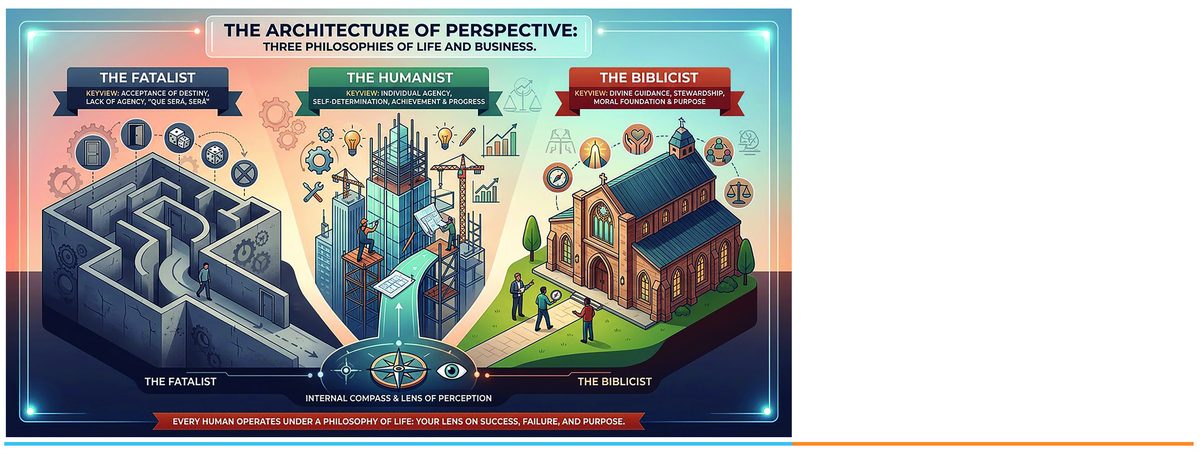
Every human being, whether consciously aware of it or not, operates under a specific “philosophy of life.” This philosophy is the internal compass that dictates how we perceive our existence, how we interact with others, and how we approach our professional endeavours. It is the lens through which we interpret success, failure, and the very purpose of our daily labour. While the complexities of human thought are vast, most worldviews can be distilled into three primary categories: the Fatalist, the Humanist, and the Biblicist.
1. The Fatalist View: Life as a Script Already Written
The Fatalist perspective is often the “default drive” for many. In this worldview, life is seen as a fixed track. Whether the governing force is labelled as fate, destiny, the “stars,” or even a misunderstood version of God’s will, the core belief remains the same: the outcome of your life is already decided, and your individual agency is largely an illusion.
The Danger of Passivity: This view is surprisingly common in religious circles, where people abandon their responsibility under the guise of “leaving it all to God.” However, this is not faith; it is an abandonment of the gift of choice. Fatalism strips away the motivation to innovate,or to improve, because it assumes that effort is ultimately futile against the backdrop of a pre-written script.
2. The Humanist View: Life as a Self-Made Masterpiece
On the opposite end of the spectrum lies the Humanist view, or what we might call the “planned drive.” This is the predominant worldview of the modern secular world, fuelled by self-help podcasts, grit-focused business books, and the “hustle culture” of Western society. The humanist believes that man is the centre of the universe. Their mantra is: “I am the master of my destiny, the captain of my ship.”
The Burden of Self-Reliance: In this framework, God and the supernatural are sidelined or entirely discarded. Success is attributed purely to one’s own intelligence, strategy, and hard work. While this view is empowering because it encourages action, it carries a hidden, heavy burden. This leads to immense pride during the good times and soul-crushing anxiety or burnout during the bad times. Furthermore, it fosters a “survival of the fittest” mentality where others—be they employees or competitors—are seen as tools or obstacles rather than fellow human beings.
3. The Biblicist View: Life as a Stewardship of Divine Trust
The third way is the Biblicist view, or the “purpose driven” This perspective offers a sophisticated balance that the other two lack. It acknowledges a divine plan (unlike Humanism) but insists on active human participation (unlike Fatalism). The Biblicist says: “I choose what God wants for my life.”
This view is rooted in the concept of stewardship. A steward is not an owner, but a manager of someone else’s property. In this context, your life, your talents, and your business assets are not yours by right; they are entrusted to you by the Creator to be grown and utilized for a higher purpose.
Redefining Business Through the Lens of Stewardship: When we apply the Biblicist philosophy to the marketplace, the nature of “work” undergoes a radical transformation. Business ceases to be a cold machine of profit and becomes a platform for spiritual and social impact.
Business as a Burden-Bearing Mechanism: To truly live out the Biblicist view in the marketplace, we must look at the instruction found in Galatians 6:2: “Carry each other’s burdens, and in this way you will fulfill the law of Christ.”
In the world of commerce, every problem a customer faces is a “burden.” A broken car is a burden; a lack of information is a burden; a complex logistical hurdle is a burden. When a business solves these problems with excellence and integrity, it is literally lifting a weight off the shoulders of another human being.
Shifting the Subconscious: Most of us operate on “autopilot” 95% of the time, driven by subconscious fears or selfish desires. By consciously anchoring our business strategy in the “5%” of our deliberate thoughts—specifically on the word of God—we can override those selfish instincts.
A Biblicist business strategy begins by identifying the burden—understanding the specific pain point the customer is struggling with. It then seeks to provide the strength by using one’s unique skills, resources, and production capacity to lighten that load. Finally, it fulfills the law by recognizing that doing excellent work is not merely economic activity, but a spiritual calling expressed through service to others.
Conclusion: The Ultimate Audit
At the end of the day, our philosophy of life shapes our legacy. In the Humanist view, the final word is bank balance or reputation. In the Fatalist view, there is no final word, because life was never truly in your control. But in the Biblicist view, there is a “Presence Reality Check,” where life is measured not by success or fate, but by faithfulness before God.
One day, every leader and individual will be asked what they did with the resources they were given. Did you hide your talent in the ground out of fear? Did you hoard it for your own glory? Or did you invest it to serve others and reflect the character of the Creator?
Viewing life and business through this lens moves the focus from “What can I get?” to “What can I grow with what I’ve been given?” When we choose the Biblicist path, our work stops being a chore and starts being a contribution. We become more than just professionals; we become stewards of a divine trust, ensuring that our businesses leave a legacy of connection, support, and lasting value.
Mr. Sangeeth Silveri, Entrepreneur, Growth Consultant, Business Mentor. With all humility, giving glory to God for 26 years of experience in various positions as a consultant.
MOBLIE: 96779 29305