Is God Against the Wealth
Recently, a teacher in Vijayawada shared a quiet but uncomfortable truth. He prays daily, seeks God’s guidance in his work, and sincerely desires to live as a faithful believer. Yet when it comes to his income, he remains guarded. He avoids speaking about his salary in church settings, not out of pride, but out of fear—fear of being misunderstood, judged, or even spiritually evaluated based on how and where he earns. What appears to be a personal hesitation actually points to something much larger. The Question We Avoid—but Cannot Escape In many Christian homes, faith and finances exist in separate worlds. Sunday is for worship, prayer, and devotion. Monday is for earning, spending, saving, and surviving. We ask God to bless us and provide for us, yet we rarely pause to reflect carefully and theologically on how we earn, how we manage money, or how our financial lives relate to our faith. As a result, money has become either a private matter no one discusses or a spiritual puzzle no one clearly understands. This silence has not remained neutral.
M. Th., Ph. D.
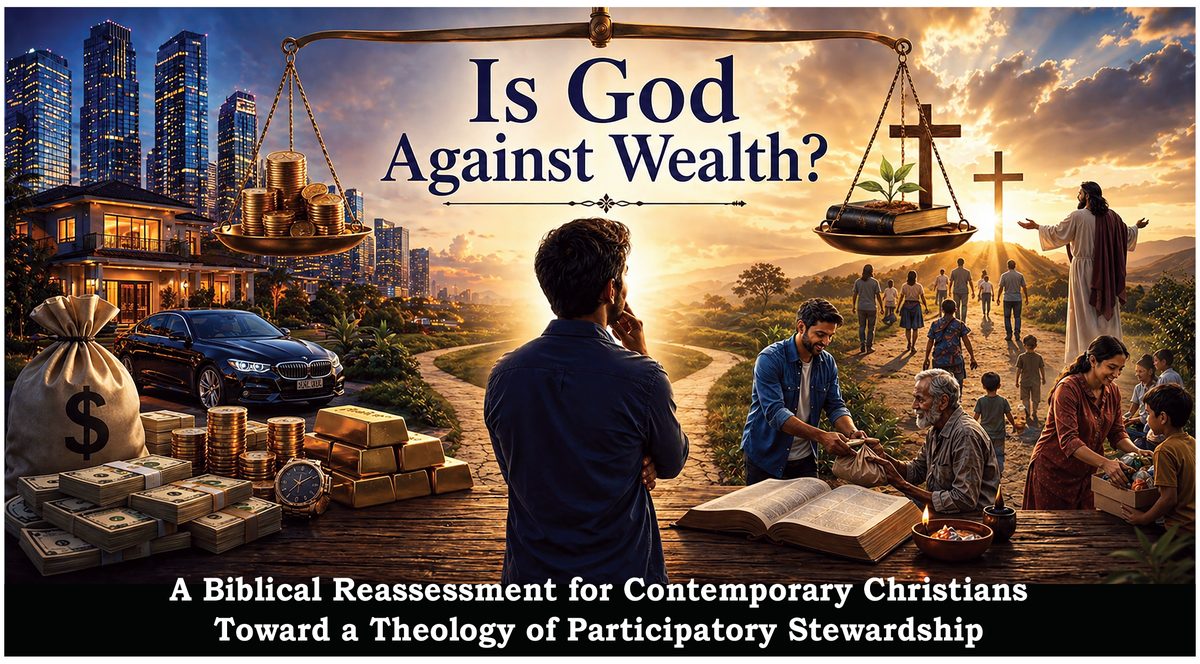
It has formed two strong and opposing extremes. On one side, some teach that God guarantees prosperity if one believes strongly enough or gives generously enough. On the other side, there exists an unspoken assumption that true spirituality requires enduring poverty, as though lack itself were a sign of holiness. Caught between these voices, many believers feel uncertain. Should they aspire and grow? Should they restrain themselves? Or simply endure their situation without question? It is precisely at this point of confusion that a deeper and more honest question emerges—one that moves beyond both extremes and seeks a truly biblical understanding of wealth, faith, and life. 1. Is God Against Wealth? This article argues for a biblically grounded answer: Wealth is not the enemy. But unexamined wealth, detached from justice, accountability, and community, is. What Is Participatory Stewardship? Before moving forward, we must define our terms clearly:
Wealth: Resources—income, land, sav ings, capital—that enable life and action.
Stewardship: Responsible, accountable use of what God entrusts.
Participation: Using resources for shared flourishing, not private accumulation.
Participatory stewardship rejects two illusions:
“I have no responsibility beyond survival.”
Instead, it affirms that we are entrusted by God (Psalm 24:1), called to participate in His work (1 Corinthians 3:9), and accountable for how we use what we receive (Matthew 25:14–30).
Or, as 1 Peter 4:10 (NRSV) says: “Like good stewards of the manifold grace of God, serve one another with whatever gift each of you has received.” 3. The Old Testament: Wealth Under Covenant Restraint The Old Testament plainly shows many great fortunes. Abraham was “very rich in livestock, in silver, and in gold” (Genesis 13:2). The fortunes of Job are highlighted before and after his trials (Job 1:3 and Job 42:10). David’s reign on the throne brought stability and peace, and the reigns of Solomon and his son were rich in gold and marked by great national and economic growth. One could easily interpret so much wealth as a sign of divine grace. But that is not the full story. In the Old Testament, wealth is never isolated; it is tied to the covenant relationship between Israel and God. In reality, prosperity is not complete ownership but conditional stewardship in the name of the Divine One. We see this clearly in the structure of Israel’s laws and policies. That is why the laws of gleaning (Leviticus 19:9–10) commanded those whom God had blessed not to reap their fields to the edges, but to leave portions for the poor and the foreigner. The cancellation of debts in Deuteronomy 15 prevented a system of permanent indebtedness and harsh economic slavery, and the Year of Jubilee (Leviticus 25) went even further by restoring land ownership to the original families. These laws show that without them, wealth and power would rapidly concentrate in ways that threatened the stability of the nation and the continuity of its community. Through these provisions, wealth and property were limited, interrupted, and redirected. The prophets sharpen this understanding. Amos denounced those who trampled “the head of the poor into the dust” (2:7). Isaiah declared, “Woe to those who join house to house, who add field to field, until there is room for no one but you” (5:8). In their words, it was greed and refusal to share—not wealth itself—that created danger. So, the Old Testament pattern is clear: God allows wealth, but He also surrounds it with boundaries, responsibilities, and occasional corrections. Wealth is permitted, but never self-directed. It must remain accountable to God’s justice and focused on the welfare of society as a whole. The theological conclusion is inevitable: In the Old Testament, wealth without justice is not a sign of blessing; it is evidence of covenant violation. This makes us read Abraham and Job differently. Their prosperity was not simply a reward, but part of a broader covenantal calling that required duty, humility, and fidelity to God’s purposes. 4. The New Testament: From Posses
The Old Testament plainly shows many great fortunes. Abraham was “very rich in livestock, in silver, and in gold” (Genesis 13:2). The fortunes of Job are highlighted before and after his trials (Job 1:3 and Job 42:10). David’s reign on the throne brought stability and peace, and the reigns of Solomon and his son were rich in gold and marked by great national and economic growth. One could easily interpret so much wealth as a sign of divine grace. But that is not the full story.
sion to Participation The New Testament does not abolish wealth, nor does it oppose it, as has long been falsely assumed. Wealth is not rejected. We find among the early Christians several wealthy believers: Joseph of Arimathea, who provided his own tomb for the burial of Jesus (Matthew 27:57–60); Lydia of Thyatira, a merchant who hosted a house church (Acts 16:14–15); and Philemon, who also hosted a house church (Philemon 1–2). Thus, rich Christians were not excluded from the Kingdom. But something fundamental changed regarding wealth. We are not moving from wealth to poverty and all that implies; rather, we are moving from possession to participation. While in the Old Testament wealth was regulated by covenantal law, in the New Testament it is reoriented by the life of the Kingdom community itself. This is best seen in Acts 2–4, where believers held possessions loosely and were generous so that “there was not a needy person among them” (Acts 4:34). It was not merely personal generosity; it was a radical reshaping of economic relationships by the reality of the resurrection and the activity of the Spirit. Ownership was not denied; rather, what people possessed was made available for the good of all. The shocking case of Ananias and Sapphira (Acts 5:1–11) provides the clearest illustration. Peter plainly said that the property was theirs to keep or sell. They were not condemned for owning property, but for deception—for acting as though they had fully participated while secretly maintaining control. The sin was not possession, but pretending that what one had was available to all. This helps us understand why Jesus speaks so sharply about wealth. To say, “You cannot serve God and money” (Matthew 6:24) is not exaggeration, but a piercing exposure of a deeper spiritual danger. To command the rich man, “Sell what you own…” (Mark 10:21), is not a universal economic principle, but a diagnosis of bondage in the heart. The parable of the rich fool (Luke 12:16–21) reveals the tragedy of a self-centered life devoted to accumulation without reference to God or others. Why is this so serious? Because wealth creates powerful misconceptions: the illusion of mastery over life, the delusion of separation from others, and the false security of independence from God. In earlier agrarian societies, dependence on God was more visible. By contrast, accumulated wealth can obscure that dependence and foster self-sufficiency.
Thus, the New Testament is not condemning wealth in itself. It is exposing its spiritual danger and redirecting it. Wealth is dangerous not because it exists, but because it can quietly replace God in the human imagination.
(To be continued)
Rev. Dr. Dola Vijay Kumar , a New Testament scholar, serves as Assistant Pastor at Santhosh Nagar Lutheran Church and is a former entrepreneur.
MOBILE: 90143 83344
Last week, as I handed my six-year- old her piggy bank money, I casually asked what she planned to do once it was full and ready to be opened. Without missing a beat, she said, “I’ll buy you a Gucci bag.” And I paused for a second, why not, indeed? Funny how she dreamed bigger for me than I ever thought to dream for myself.
Across Scripture, women are not merely passive participants in God’s story. They are strategists and system-builders. She is not confined to domestic work alone. She is an investor, entrepreneur, and wealth creator. This reflects a powerful truth, economic empowerment in the Bible often begins at home, but it does not end there.
God’s Design: Prosperity with Purpose: Before we speak of women, we must reaffirm a biblical truth that God does not glorify lack rather He glorifies fruitfulness. Proverbs 10:22 reminds us “The blessing of the Lord brings wealth, without painful toil for it.” 3 John 1:2 declares: “I pray that you may prosper in all things and be in health, just as your soul prospers.”
These scriptures reveal that God desires holistic prosperity that is spiritual, physical, and economic. Throughout the Bible, God raises individuals not just to survive, but to lead, influence, and govern.
The Woman Who Builds: Economic Intelligence in the Home: Proverbs 14:1 says, “The wise woman builds her house, but with her own hands the foolish one tears hers down.” This is not merely about domestic stability but it is about economic architecture. A “house” in biblical terms represents legacy, wealth, and generational continuity.
The Proverbs 31 woman is perhaps the most complete economic model in Scripture. She is not confined to household chores. She is a multi-sector leader: She considers a field and buys it (real estate decision-making). She plants a vineyard (long-term investment). She trades profitably (entrepreneurship. She ensures her household is clothed and secure (resource management). In short, this is economic literacy embedded in faith. That is powerful.
Women as Catalysts of Strategic Change: Deborah, one of the finest and most influential leaders of the time, stands as a judge and national leader during a time of crisis. Her leadership was not symbolic, it was administrative, judicial, and military. She guided a nation toward stability. Imagine that!
Esther operated within political systems, using influence, timing, and wisdom to alter the fate of an entire people. Her intervention preserved not just lives, but the future economic and social continuity of a nation.
The Shunammite woman (2 Kings 4) demonstrates strategic hospitality and asset creation. She identifies opportunity, builds an upper room, and creates a space that becomes a channel of divine blessing. Her story reflects foresight, the ability to recognize value and invest in it. These women did not wait for empowerment. They exercised stewardship within the spaces they had.
Rethinking Women’s Role in Economic Empowerment: Within many Christian settings today, women continue to be pillars of faith, prayer, and service. Yet their potential as economic drivers often remain underdeveloped. If Scripture presents women as investors, planners, and leaders, then modern Christian communities must move beyond limiting roles and start to think about creating – wealth and legacies. Economic empowerment of women is not a social trend. It is a biblical restoration.
Wealth as Generational Responsibility: One of the most profound yet overlooked truths is found in Proverbs 13:22: “A good person leaves an inheritance for their children’s children.” Inheritance is not accidental. It is intentional wealth transfer. And in many families, it is women who manage continuity through discipline, savings habits, and value systems.
A New Call: From Supporters to Stakeholders: If the Christian community must evolve economically, it cannot do so while underutilizing half its strength. Churches and institutions must therefore encourage women-led entrepreneurship, provide financial literacy platforms specifically designed for women, create mentorship networks that connect experienced professionals with young women, and recognize and celebrate economic leadership alongside spiritual service. This is not to be looked at as replacing roles but it is about expanding impact.
When Women Rise, Communities Flourish: Economic empowerment in the Christian context is not merely about wealth accumulation. It is about alignment with God’s design for dominion, stewardship, and influence. And within that design, women are not secondary. They are central.
When women are empowered with knowledge, opportunity, and support, homes become stronger, institutions become sustainable, and communities become resilient.