Feeding the Poor
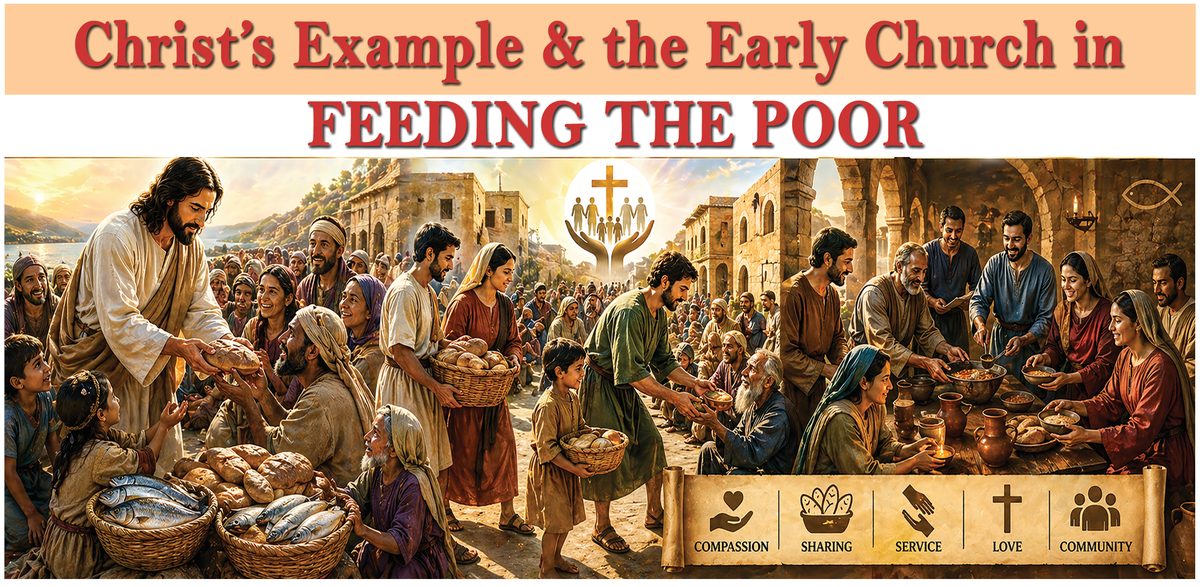
The New Testament emphasizes that feeding the hungry is a tangible sign of faith and a direct service to Christ Himself.
Miraculous Provision: Jesus miraculously fed thousands (the 5,000 and the 4,000) using minimal resources, demonstrating God’s abundant care for physical needs.
The Final Judgment: In Matthew 25 : 35-40 Jesus reveals that eternal destiny is linked to how one treats “the least of these,” stating, “For I was hungry and you gave me food”.
The Early Church: The first Christian communities lived communally, sharing everything they had so that “there was not a needy person among them”.
Faith and Works: The book of James argues that faith without action is “dead,” specifically using the failure to provide food for a hungry brother or sister as proof of a hollow faith.
In the Gospel of Matthew feeding the hungry is portrayed as a physical expression of divine compassion and a central criterion for final judgment. Jesus elevates the act of providing food from a charitable suggestion to a core requirement for his followers.
In the Gospel of Mark, feeding the hungry is presented as an urgent, hands-on priority that reveals the heart of Jesus. Mark’s fast-paced narrative highlights that Jesus never let “spiritual” work get in the way of meeting “physical” needs.
In the Gospel of Luke, often called the “Gospel of the Poor,” feeding the hungry is the primary evidence of the Kingdom of God breaking into the world. Luke emphasizes that Jesus came to flip the social order so the hungry are filled and the rich are sent away empty.
In the Gospel of John, feeding the hungry moves from a social duty to a profound spiritual revelation. John uses the physical act of eating to explain how Jesus sustains the human soul eternally.
In the Book of Acts, feeding the hungry moves from a miracle performed by Jesus to a systematic lifestyle for the early Church. It shows that the Holy Spirit’s first impact on the believers was to make them radically generous with their food.
In the Book of Romans, feeding the hungry moves from a community project to a fundamental mark of a transformed mind. Paul argues that if you have truly experienced God’s mercy, it will naturally flow out of you as practical kindness toward others.
I n 1 and 2 Corinthians, feeding the hungry moves from a “nice gesture” to a test of church unity and a demonstration of God’s grace. Paul corrects a wealthy church that was feasting while their poor members went hungry.
The book of Galatians emphasizes the importance of helping the poor and needy as a direct outworking of faith and the Gospel. While it doesn’t use the specific phrase “feeding the hungry,” it provides clear instructions on caring for the destitute and performing “good works” for others.
In the book of Ephesians, the theme of “feeding the hungry” is addressed through the broader lens of Christian generosity and the transformation of a believer’s character. While it lacks a direct command with the specific phrase “feed the hungry,” it provides a powerful theological and practical framework for meeting the physical needs of others.
In the book of Colossians, the specific phrase “feeding the hungry” does not appear. Instead, Paul focuses on the internal transformation of the believer, which naturally leads to outward acts of mercy and charity. Colossians 3:12: “Therefore, as God’s chosen people, holy and dearly loved, clothe yourselves with compassion, kindness, humility, gentleness and patience.”
In the letters to the Thessalonians, Paul’s instructions on feeding the hungry are tied directly to the theology of work and communal responsibility. Rather than just a general call to charity, these books address how a healthy church community provides for its members.
In the letters to Timothy, Paul moves from general encouragement to specific church policies for feeding the hungry. These books provide the clearest
“manual” in the New Testament for how a local church should manage its resources to care for the destitute. 1 Timothy 6:17–19 (The Duty of the Wealthy): Paul tells Timothy to command the wealthy “to be rich in good deeds, and to be generous and willing to share.” This was the practical way the church funded its food programs for the poor.
In the book of Titus, Paul’s instructions on feeding the hungry are framed as “doing what is good” to meet urgent needs. Since Titus was overseeing the churches on the island of Crete—a culture Paul describes as “lazy gluttons” (Titus 1:12)—the emphasis is on a radical shift toward productivity and generosity.
In the short, personal letter to Philemon, the theme of “feeding the hungry” is addressed through the lens of hospitality and the restoration of a household. While this letter focuses on the relationship between a slave-owner (Philemon) and his runaway slave (Onesimus), it provides a powerful picture of how the early church shared meals and resources.
In the book of Hebrews, feeding the hungry is presented as a “sacrifice” that is pleasing to God. It moves from the Old Testament system of animal sacrifices to the New Testament practice of tangible kindness and shared resources.
In the Book of James, feeding the hungry is not just a suggestion; it is the ultimate “litmus test” for whether a person’s faith is genuine or dead. James is famously blunt about the necessity of physical provision. James 2:14–17:
“What good is it, my brothers and sisters, if someone claims to have faith but has no deeds? Can such faith save them? Suppose a brother or a sister is without clothes and daily food. If one of you says to them, ‘Go in peace; keep warm and well fed,’ but does nothing about their physical needs, what good is it? In the same way, faith by itself, if it is not accompanied by action, is dead.”
In the letters of 1 & 2 Peter, feeding the hungry is framed through the lens of hospitality and mutual support during times of intense suffering and persecution. Peter focuses on how a community survives under pressure by sharing what they have. 1 Peter 4:10: “Each of you should use whatever gift you have received to serve others, as faithful stewards of God’s grace in its various forms. “Peter views food and resources not as personal property, but as “God’s grace” that believers are managing. If you have extra food, you are a “steward” responsible for getting it to someone who is hungry.
In the letters of John, feeding the hungry is the ultimate proof of whether a person actually knows God. John moves past “nice ideas” about love and insists that if you don’t help people with their physical needs, you don’t truly have God’s love in you. 1 John 3:17– 18: “If anyone has material possessions and sees a brother or sister in need but has no pity on them, how can the love of God be in that person? Dear children, let us not love with words or speech but with actions and in truth.”
Jude, feeding the hungry is discussed in the context of the “Agape Feasts” (Love Feasts). Jude uses the misuse of these communal meals as a primary reason for his warning against false teachers. Jude 1:12: “These people are blemishes at your love feasts, eating with you without the slightest qualm— shepherds who feed only themselves.” Jude 1:22–23: “Be merciful to those who doubt; save others by snatching them from the fire; to others show mercy, mixed with fear...”
In the book of Revelation, the theme of feeding the hungry reaches its ultimate conclusion. While the rest of the New Testament focuses on the duty of believers to feed one another, Revelation focuses on the divine solution to human hunger and the final satisfaction of all needs. Revelation 7:16–17: “Never again will they hunger; never again will they thirst... For the Lamb at the centre of the throne will be their shepherd; he will lead them to springs of living water.”
JESUS SAID IN MATTHEW 25:35-40
“For I was hungry and you gave me something to eat, I was thirsty and you gave me something to drink, I was a stranger and you invited me in, I needed clothes and you clothed me, I was sick and you looked after me, I was in prison and you came to visit me.”
“Then the righteous will answer him, ‘Lord, when did we see you hungry and feed you, or thirsty and give you something to drink? When did we see you a stranger and invite you in, or needing clothes and clothe you? When did we see you sick or in prison and go to visit you?’”
“The King will reply, ‘Truly I tell you, whatever you did for one of the least of these brothers and sisters of mine, you did for me.’”
3 Key Lessons from this Passage
1. Direct Identification with the Poor: Jesus doesn’t just say that helping the hungry is a “good deed”—He says that He personally inhabits the person who is hungry. To feed a starving person is, in a mystical and spiritual sense, to feed Jesus Himself.
2. The “Least of These”: The “least” refers to those with the lowest social status: the orphans, the widows, the homeless, and the destitute. Jesus elevates the importance of those the world often ignores or oppresses.
3.The Surprise of the Righteous: Notice that the “sheep” (the righteous) are surprised. They weren’t doing these acts to “earn” heaven or to be seen by God; they were simply acting out of genuine compassion. Their faith naturally produced the “fruit” of feeding and clothing others.
A soul without a body cannot be saved, we are encouraged through the Bible to take care of the daily needs of the least of these, Food, Clothing & Shelter and by doing so we invite them to participate in the free gift of salvation offered to them by our LORD and Saviour Jesus Christ.
Rev. Dr. Samuel Karan does a thorough rundown of the above scriptures to encourage the church to actively participate in serving the least of these around us every day. Pastor Samuel Karan serves on the streets every day since 2009. Once waited on the streets for someone to extend a helping hand, after an encounter with JESUS in 2007, His life was restored to be able to reach out to the people on the streets in Hyderabad and other parts of the nation.
While he preached love and faith in action, he prays that the global church will step out of the comfortable chairs in the church into the streets to reach the Orphans Oppressed and The Destitute.
GOD blessed Pastor Samuel Karan with the ministry “FOOD” “Feeding Orphans Oppressed and Destitute” that serves free breakfast every day at Clock Tower Secunderabad from the past 9 years.
Rev. Dr. Samuel Karan First Servant: Grace in Faith Temple FOOD – Feeding Orphans, Oppressed, and Destitute
MOBILE: 85008 00777
Asignificant missional initiative was launched by Rev. Dr. N. Michael Prasad at a special gathering titled “A Dialogue with the Church,” held at Rev. Campbell Hall, on the premises of Centenary Baptist Church, on April 14, 2026, in Secunderabad. Around sixty Baptist leaders and decision-makers from various churches participated in this mission-casting meeting.
With over 35 years of pastoral experience and strong theological grounding from Andhra Christian Theological College and Henry Martyn Institute, Rev. Dr. Prasad has now dedicated his life to advancing a renewed threefold mission vision for the Church.
1. Pastoral Care to the Diaspora:
Focusing on migrants in metropolitan cities like Hyderabad, this vision seeks to disciple believers, plant new churches, and build strong faith communities among diverse linguistic
Congratulating Rev. Dr. N. Michael Prasad groups.
2. Telugu Baptist Missionary Alliance:
A new platform to unite Telugu Baptist Churches for supporting theological students, sending trained pastors to mission fields and strengthening collective mission efforts.
3. Interfaith Dialogue:
Presented as a biblical and practical mission strategy, Interfaith Dialogue promotes meaningful engagement in a pluralistic society. Rooted in Baptist heritage and echoed by global bodies like the World Council of Churches, it offers a constructive way to witness Christ while fostering peace and understanding.
An Invitation to Partner Church leaders, pastors, theological students, and mission-minded believers are invited to be part of this transformative movement.
Prof. Joab Lohara’s The Carpenter Who Shaped the Universe was launched nationwide. The first release took place in Secunderabad on 5th April 2026, followed by New Delhi on 23rd April, Cuttack on 26th April, Mumbai on 9th May, Kolkata on 23rd May, and Dimapur on 24th May 2026.
The inaugural launch in Secunderabad was held at Hotel Grand Continent, where Padma Shri Prof. Kolakaluri Enoch formally released the book at a special function.
The 390-page volume, authored by Prof. Joab Lohara, explores lesser-known aspects of the life of Jesus Christ, including reflections on His childhood and the mystery surrounding His “missing years.”
Speaking on the occasion, Prof. Enoch remarked that the book presents the Saviour in His humble role as a carpenter while offering profound spiritual insights. He described Prof. Lohara as a distinguished intellectual, writer, and philanthropist, and said it was a privilege to release his work.
Addressing the gathering, Prof. Lohara stated that each chapter contains thought- provoking reflections intended to inspire readers and help them gain a deeper understanding of Christ’s life and message.
The meeting was chaired by Sam Paul Kolakaluri, a former State Level Member of the Prime Minister’s 15-Point Programme for Minorities. Among those present were Rev. Obed Missal, Dr. Vasanth Kumar, Shri Shankar Luke, Dr. John Amalraj, and other distinguished guests.