Faith and Fortune

As I begin to write this article, I am reminded of my grandfather, a great man of God, Rev Dr. G.C. Krupaiah, who was the first Christian in his generation to dream beyond the boundaries of a small congregation. At a time when resources were scarce and opportunities limited, he built not just a church, but established many schools and hostels, a clinic, trained many people to serve God and carried the message of Christ to many villages that had never heard the Gospel before.
His phenomenal work empowered hundreds of families to live a life of dignity and hope they had never imagined possible in the erstwhile Mahbubnagar District. It reminds me that Gospel does not only transform hearts, but also transforms livelihoods. True Christian ministry uplifts communities spiritually, socially and economically.
For generations, the Christians of India have been a community of compassion, service and sacrifice. Thousands of schools, hospitals and social welfare organizations have been established by churches, missionaries and Christian institutions that provide services to millions of people. In many villages and towns, the first modern school or hospital was a Christian establishment. This legacy and service is one of the greatest gifts that the Christian community has made to Indian society.
But there is a question that Christians rarely ask themselves why is it that a community which has contributed so much to education and social service is practically weak in economic power?
Often, questions about economic empowerment are conspicuously absent from church gatherings. Around the Lord we talk about faith-about spirituality, morality and charity. These things are fundamental to being a Christian, but we often ignore an important consideration in biblical teaching, the responsible creation and stewardship of wealth.
The Economic Reality of Christians in India: Brief statistical data.
According to census data, Christians constitute about 2.3% of India’s population, that is around 28 million people. In Telangana, Christians account for approximately 1.27% of the population, about 4.4 lakh people, though many believe the actual number may be higher.
Despite high literacy levels and strong representation in professions like education, nursing, and social work, Christians are relatively underrepresented in large scale entrepreneurship, industry, and business networks. Many Christian families rely heavily on salaried jobs rather than business ownership.
This pattern has both historical and social reasons. A significant number of Indian Christians come from historically marginalized communities that embraced Christianity seeking dignity, education, and social justice. While conversion opened doors to education, economic mobility often remained limited.
As a result, the community developed a culture of service professions rather than wealth creating enterprises. While service is noble, economic strength is equally important for sustaining institutions, supporting missions, and empowering future generations.
The Ingrained Misunderstanding About Wealth
Psalm 112:3 “Wealth and riches are in their houses, and their righteousness endures forever”.
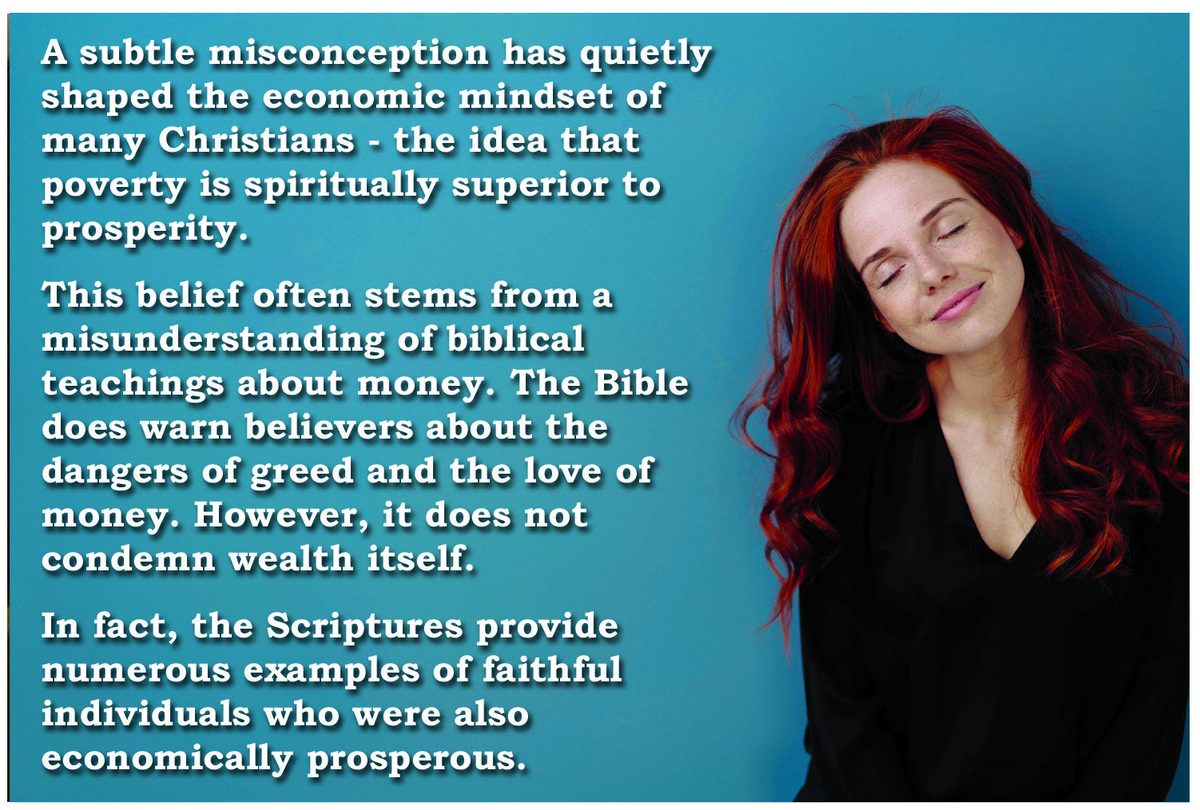
A subtle misconception has quietly shaped the economic mindset of many Christians - the idea that poverty is spiritually superior to prosperity. This belief often stems from a misunderstanding of biblical teachings about money. The Bible does warn believers about the dangers of greed and the love of money. However, it does not condemn wealth itself. In fact, the Scriptures provide numerous examples of faithful individuals who were also economically prosperous.
Abraham, the father of faith, was described as “very wealthy in livestock, silver, and gold” (Genesis 13:2). King David and King Solomon ruled over prosperous kingdoms. Joseph became the economic administrator of Egypt and managed resources during a time of global famine. Lydia, mentioned in the New Testament, was a successful merchant whose home became a center for early Christian ministry.
These examples show that wealth, when guided by righteousness, can serve God’s purposes. The real biblical warning is not against wealth but against allowing wealth to replace God at the center of life.
A Rarely Discussed Issue: Economic Dependence
Another challenge within the Christian community is economic dependence on external support. Historically, many Christian institutions were funded by missionary organizations from Europe and North America. While this support enabled tremendous social progress, it also created a pattern where local communities did not always develop strong financial self-reliance.
Today, global funding patterns are changing. Churches and institutions increasingly need local economic sustainability. This shift requires a mindset change from dependence to empowerment.
The Untapped Strength of Christian Education
Ironically, one of the greatest economic resources of the Christian community already exists and that is education. Christian schools and colleges have educated millions of Indians, including political leaders, entrepreneurs, scientists, and public servants. Yet relatively few graduates from these institutions channel their success back into strengthening Christian economic networks. Andhra Christian College, Guntur (Notable alumni include Kasu Brahmananda Reddy, Former CM of Andhra Pradesh, Sir N G Ranga- legendary freedom fighter and economist), St. Joseph’s College, Tiruchirapally (APJ Abdul Kalam, the missile man of India and Former President of India), Madras Christian College and many other institutions.
Imagine the impact if Christian entrepreneurs, professionals, and investors actively collaborated to mentor young people, create start- ups, and fund community initiatives. Economic empowerment is not about creating wealth for its own sake. It is about building sustainable ecosystems that uplift entire communities.
Rediscovering the concept of WORK according to Bible.
In the parable of Talents (Matthew 25:14-30), the master praises servants who multiplied their resources. God expects believers to multiply resources and opportunities, not simply preserve them. In the book of Genesis, even before the fall of humanity, God entrusted Adam with the responsibility of cultivating and managing the Garden of Eden.Work was not a curse. It was part of God’s design.
Jesus himself spent much of his life as a carpenter. The Apostle Paul worked as a tentmaker while preaching the gospel. These examples remind us that productive work and enterprise are forms of stewardship. Christians are called not only to serve but also to build, create, and manage resources responsibly.
Practical Steps Toward Economic Empowerment
Ecclesiastes 11:2 “Invest in seven ventures, yes, in eight; you do not know what disaster may come upon the land.”
First, churches must encourage entrepreneurship alongside traditional professions. Young Christians should be inspired not only to seek employment but also to create businesses that generate jobs. It would be interesting to know how many Christian graduates have enrolled in T-Hub for their business incubation ideas.
Second , financial literacy must become a priority. Understanding savings, investments, and wealth management can transform the economic stability of families. This must be made a part of revival and youth retreats.
Third , successful Christian professionals should actively mentor young people. Knowledge sharing can accelerate economic mobility within the community. Churches can look into starting a dedicated wing for the purpose.
Fourth , cooperative economic models can be developed. Small investment groups, start up incubators, and business networks within Christian communities can create opportunities for collective growth.
Wealth as a Tool for Mission
Ultimately, economic empowerment should not be seen as a departure from Christian spirituality. Rather, it should be viewed as an extension of Christian mission. When believers prosper with integrity, they gain the capacity to support education, healthcare, social welfare, and missions on a larger scale.
The Bible reminds believers in Deuteronomy 8:18: “Remember the Lord your God, for it is He who gives you the ability to produce wealth.” This verse reveals that the ability to create wealth itself is a gift from God, one that must be used wisely and generously.
A New Vision for the Future
The Christian community in India stands at an important moment in history. Its spiritual heritage is strong, its educational influence is vast, and its values of compassion and service remain deeply respected.
What is needed now is a renewed vision that combines faith with economic strength. If Christians embrace both spiritual devotion and responsible wealth creation, they can become not only servants of society but also builders of institutions, innovators in business, and leaders in national development. Faith and prosperity need not be enemies. When guided by humility, integrity, and generosity, economic empowerment can become one of the most powerful expressions of Christian witness in the modern world.
Dr. Rini Anweshi works in the Prohibition and Excise Department, Government of Telangana. She is also the founder of the Nature Restoration Centre, a NGO that works actively in areas such as poverty alleviation, support for orphanages and hospitals, education, and the empowerment of marginalized communities.
MOBILE 96428 28840