Economic Empowerment of Minorities
Economic empowerment is a cornerstone for the progress and dignity of any community. As Babasaheb Dr. B.R. Ambedkar rightly emphasized, economic strength is the foundation upon which social justice and political participation are built. Without financial independence, communities remain vulnerable to marginalization and exclusion. Similarly, Jawaharlal Nehru’s vision of planned development underscored the importance of inclusive growth, ensuring that minority groups are not left behind in the nation’s march toward progress. For Christian minorities in India, particularly in states like Telangana and Andhra Pradesh, economic empowerment is not merely a policy goal but a moral imperative that directly impacts their ability to thrive in education, employment, and social leadership.
Current Context
Christian minorities, especially youth and women, continue to face significant challenges in achieving economic independence. The Government Order that carved the State Christian Minorities Finance Corporation was a noble act of the leaders of that time, and it continues to provide support. While education and hostel facilities have received attention through government schemes such as those offered by the Telangana State Christian Minorities Finance Corporation, there remains a noticeable gap in initiatives that directly address financial empowerment. Scholarships and accommodation support are valuable, but they do not translate into long-term livelihood opportunities.
The absence of comprehensive surveys or audits on the economic status of Christian minorities further compounds the issue, leaving policymakers and community leaders without reliable data to design effective interventions. This lack of structured assessment means that the community’s advancement or lag in economic terms remains largely anecdotal rather than evidence based.
Key Issues
As State Level Member of the Prime Minister’s 15 Point Program for the Welfare of Minorities, and through interactions with various ministries, district officials, and with key Christian, Muslim and other leaders, I gathered the following issues we face in this area:
Limited focus on economic schemes: Existing programs prioritize education and accommodation, but there is insufficient emphasis on entrepreneurship, skill development, and financial independence.
Youth and women underrepresented: Christian minority youth and women often remain excluded from targeted schemes, despite their potential to drive sustainable community growth. Women are key influencers through family and community connections, while youth represent the future; together they form the backbone of the community.
Church Institutions and Educational Excellence: Churches serve as central institutions across the country and in many states, providing quality education and shaping generations of students. I was present on the dais during a meeting where Telangana Chief Minister Mr. Revanth Reddy rightly observed that every segment of society seeks admission in Christian institutions. He emphasized that the management and academic excellence of these institutions are of such a high standard that even the resourceful government cannot match the quality offered by church-run schools and colleges.
Untapped Potential in Economic Empowerment: While their contribution to education is widely recognized and celebrated, church-run institutions have not yet extended their organizational capacity into the sphere of economic empowerment. This side of their mission remains largely untapped, presenting an opportunity for churches to build upon their proven strengths in education and expand their impact into livelihood creation, entrepreneurship, and financial inclusion. By broadening their role, churches could complement their educational excellence with initiatives that uplift the economic well-being of Christian minorities, particularly youth and women.
Accessibility and transparency gaps: Even where schemes exist, bureaucrat ic hurdles, the BC-C certificate confusion (borne caste certificate versus one’s choice of faith), and lack of awareness prevent many eligible beneficiaries from accessing available schemes.
Absence of monitoring mechanisms: Without proper audits, it is difficult to measure the impact of existing programs or identify areas requiring urgent intervention.
My Recommendations
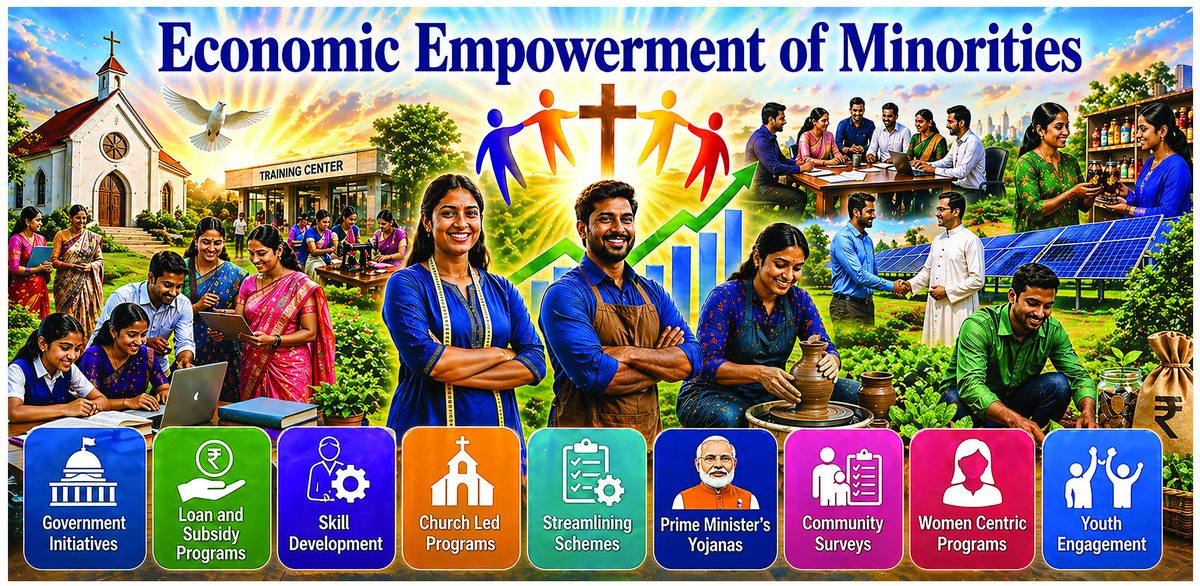
1. Government Initiatives: Publicize widely that non-statutory benefits can be availed by all SC certificate holders. Launch new schemes specifically dedicated to the economic empowerment of Christian minorities, with a minimum dedicated budget of Rs.100 crores. These schemes should go beyond scholarships and focus on livelihood creation, entrepreneurship, capacity building, and financial inclusion.
2. Loan and Subsidy Programs: Existing financial schemes should be revamped to provide low-interest loans and targeted subsidies not only for individuals but also for small-scale industry projects, mid-level enterprises, and macro-level industrial setups. By widening the scope in this way, the community can nurture a pool of emerging industrialists and economy generators. Special emphasis should remain on youth and women entrepreneurs, while also creating pathways for start-ups, self-help groups, and enterprises that contribute to sustainable livelihood creation. This layered approach ensures that Christian minorities are empowered across different levels of industry, building both individual prosperity and collective economic strength to the nation.
3. Skill Development: Establish training centers that focus on modern skills and industry trends such as digital literacy, vocational education, and entrepreneurship. These centers should also provide mentorship and incubation support for innovative business ideas. Dr. Praveen Kumar, IPS, in his role as Secretary of Social Welfare Schools in Telangana, went beyond academics to pioneer financial empowerment among underprivileged children. During one of my visits to the hostels he developed, one of his most visionary initiatives stood out—introducing students to the stock markets. By teaching them to understand financial systems and investment principles from an early age, he instilled the values of independence, responsibility, and economic self-reliance. This forward-looking approach ensures that the children are not only educated but also equipped to become financially empowered citizens and future contributors to the nation’s economy.
4. Church Led Programs: Encourage churches to collaborate with government bodies and NGOs to design community-based economic initiatives. Churches can serve as hubs for training, microfinance, and cooperative societies, thereby extending their role beyond spiritual guidance to practical empowerment.
5. Streamlining Schemes: Existing government schemes must be simplified, made more accessible, and implemented with full transparency. A single-window application system, supported by digital monitoring, can significantly reduce bureaucratic delays and improve efficiency. It is often said that by the time one secures approval for a government scheme, their footwear may be worn out from repeated visits—or worse, after all this effort that scheme is not even approved at all. Streamlining processes will ensure that such frustrations become a thing of the past, allowing genuine beneficiaries to receive timely support with dignity and ease.
6. Prime Minister’s Yojanas: The innovative schemes launched under the vision of Sabka Saath, Sabka Vikas by Prime Minister Narendra Modi provide a comprehensive framework for inclusive growth. With nearly over sixteen flagship programs covering areas such as housing, healthcare, skill development, entrepreneurship, and financial inclusion, these initiatives are designed to uplift every segment of society. It is imperative that the Christian community fully utilizes these opportunities. The Finance Corporations in both Telangana and Andhra Pradesh must take proactive steps to widely publicize these schemes and ensure that eligible beneficiaries are guided to avail them. By embracing these Yojanas, Christian minorities can strengthen their economic foundations and participate more meaningfully in the nation’s development journey.
7. Community Surveys: Conduct regular audits and surveys to assess the economic progress of Christian minorities. Data-driven insights will help tailor schemes to actual needs and measure long-term impact.
8. Women Centric Programs: Introduce special initiatives for women, including self-help groups, micro-enterprises, and vocational training in areas such as healthcare, education, and hospitality. Empowering women economically has a multiplier effect on family and community well-being.
9. Youth Engagement: Create platforms for Christian youth to access internships, apprenticeships, and entrepreneurial opportunities. Linking them with industry partners and government programs will ensure they are not left behind in the competitive job market.
Conclusion
Economic empowerment is not just a financial necessity but a social and moral imperative. Strengthening the economic foundations of Christian minorities, particularly youth and women, will ensure dignity, self-reliance, and holistic community development while harnessing their contribution to nation building. Both government and church institutions must recognize that education alone cannot guarantee empowerment unless it is coupled with livelihood opportunities and financial independence. By launching dedicated schemes, streamlining existing programs, and fostering collaboration between state and church, a pathway can be created for sustainable progress. A focused commitment to economic empowerment will pave the way for Christian minorities to contribute meaningfully to India’s inclusive growth story, ensuring that no community is left behind in the pursuit of prosperity and justice.
Dr. Sam Paul Kolakaluri, Former State Level Member of Prime Minister’s 15 Point Program for Minorities, & Founder President, National Christian Council. Email: founder@nationalcouncil.in