Economic Empowerment of Minorities
Economic empowerment is one of the most important dimensions of social justice, national development, and inclusive governance. While political representation, cultural identity, educational advancement, and religious freedom remain vital concerns for minority communities, sustainable economic empowerment is often the foundation upon which all other forms of progress are built. A community that possesses economic security is better positioned to access quality education, improve healthcare outcomes, create employment opportunities, preserve its cultural heritage, and participate confidently in the democratic process.
India’s strength lies in its diversity. The Constitution of India, drafted under the chairmanship of Babasaheb Dr. B. R. Ambedkar, recognizes this diversity and guarantees equality, justice, liberty, and fraternity to all citizens regardless of religion, language, caste, ethnicity, or region. The vision of the Constitution is not merely the absence of discrimination but the active creation of opportunities that enable every citizen and every community to contribute to national progress. In this context, minority empowerment is not a matter of charity or concession; it is a matter of constitutional responsibility, social equity, and national development.
Despite significant progress over the decades, many minority communities continue to face economic challenges. These include limited access to credit, lower levels of financial inclusion, educational disadvantages, inadequate awareness of government schemes, regional disparities, and barriers to entrepreneurship. While numerous welfare programs and development initiatives have been introduced by both the Central and State Governments, the benefits often fail to reach the intended beneficiaries in a timely and effective manner. Consequently, a gap frequently exists between policy formulation and actual outcomes on the ground.
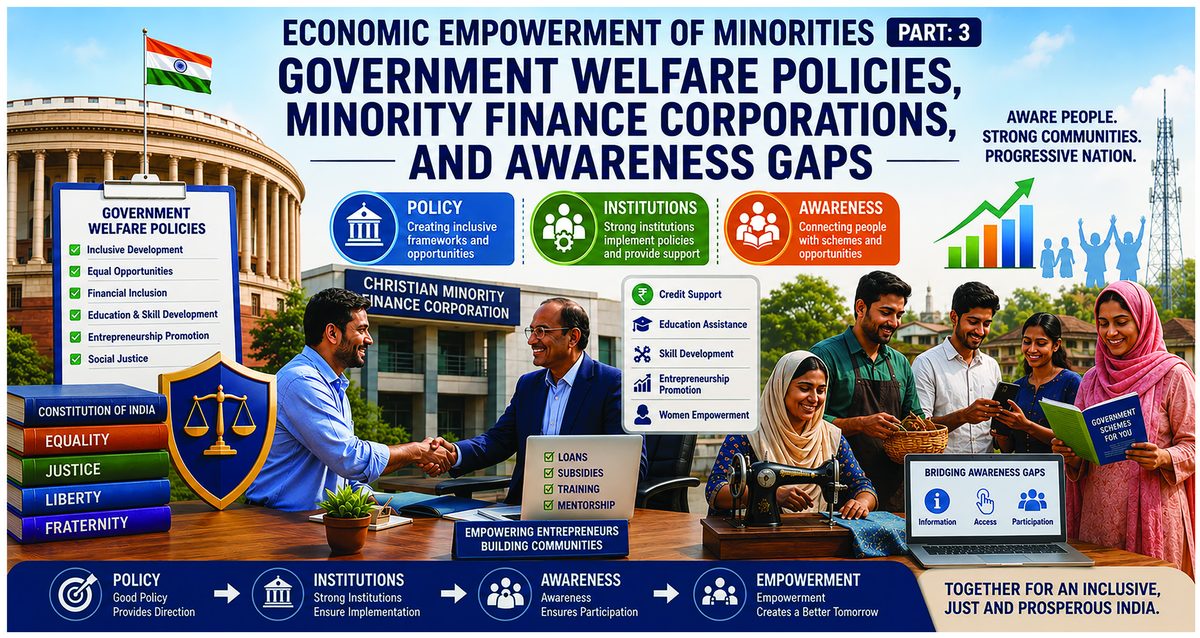
E conomic empowerment, therefore requires more than the announcement of welfare schemes. It requires a comprehensive ecosystem in which policies are thoughtfully designed, institutions are effectively established and strengthened, and communities are adequately informed and equipped to access available opportunities. When any one of these components is weak, the entire process of empowerment suffers. Strong policies without capable institutions remain only promises on paper. Strong institutions without public awareness remain underutilized. Awareness without supportive policies and institutional backing leads to frustration and unmet expectations. True empowerment occurs only when all three dimensions work together in harmony.
Let us examine the three interconnected pillars that are essential for the economic advancement of minorities:
First, Policy. Government welfare policies create the framework through which opportunities, resources, and support systems are extended to marginalized communities. These policies represent the commitment of the state to inclusive development and equal opportunity.
Second, Institutions. Policies require institutional mechanisms for implementation. Christian Minority Finance Corporations and related agencies serve as bridges between government intentions and community realities. Through credit support, subsidies, skill development, educational assistance, and entrepreneurship promotion, these institutions transform policy objectives into tangible benefits.
Third, Awareness. Even the most progressive policies and well-structured institutions cannot achieve their objectives if the intended beneficiaries remain unaware of the opportunities available to them. Awareness is, therefore, the critical link that connects people with programs. In an age of rapid digital transformation, challenges such as literacy barriers, language barriers, rural connectivity gaps, and the digital divide make awareness-building more important than ever before.
The relationship between these three pillars may be compared to a three- legged foundation supporting a structure. Policy provides direction, institutions provide implementation, and awareness provides participation. Remove any one of these pillars and the structure becomes unstable. Strengthen all three, and the result is a sustainable and inclusive economic growth.
Economic empowerment does not happen automatically. It begins with enlightened policies, is implemented through effective institutions, reaches people through awareness, and ultimately results in transformation. When policy is sound, institutions are strong, and awareness is widespread, empowerment becomes not merely an aspiration but a reality.
The discussion that follows explores these three dimensions in detail, highlighting both achievements and challenges. It also emphasizes the need for governments, civil society organizations, faith-based institutions, community leaders, financial agencies, educational institutions, and minority communities themselves to work collaboratively toward a shared goal: creating an environment in which every citizen can achieve economic security, dignity, and self-reliance.
Only through the effective integration of policy, institutions, and awareness can minority communities become full and active participants in India’s economic growth story, contributing their talents, entrepreneurship, creativity, and leadership to the development of the nation.
1. Importance of Government Welfare Policies
Public policy is the primary instrument through which governments identify national priorities, allocate resources, and address social and economic challenges. In the context of minority empowerment, welfare policies provide the strategic direction necessary to ensure that development reaches all sections of society.
Economic and soci al disparities rarely disappear on their own. They require deliberate policy interventions that recognize existing challenges and create pathways for advancement. Effective welfare policies help governments move beyond poll promises, general declarations and translate public commitments into measurable programs and outcomes.
Why Welfare Policies Matter
u Setting National Priorities: Welfare policies demonstrate the commitment of governments to inclusive development and signal that the concerns of minority communities are part of the national development agenda.
u Resource Allocation: Policies provide the framework through which funds are budgeted and distributed for education, housing, entrepreneurship, skill development, and other welfare initiatives.
u Creating Opportunities: Well-designed policies expand access to education, employment, finance, and public services, enabling individuals and communities to improve their socio-economic conditions.
u Providing Direction and Continuity: Policies create long-term development goals that continue beyond individual projects, administrations, or political cycles.
u Encouraging Participation: When communities see their concerns reflected in public policy, they are more likely to engage constructively with government programs and development initiatives.
Principles of Effective Minority Welfare Policies
For welfare policies to be meaningful, they should be guided by certain principles:
u Inclusiveness – ensuring that development reaches every section of society.
u Equity – recognizing that different communities may require different levels of support to achieve comparable outcomes.
u Accessibility – making benefits simple to understand and obtain.
u Accountability – ensuring responsible use of public resources.
u Sustainability – focusing on long- term empowerment rather than short- term assistance.
Government welfare policies, therefore, serve as the vision and roadmap for minority empowerment. They identify needs, establish priorities, allocate re sources, and create opportunities. Every successful initiative, institution, and development program ultimately begins with a policy decision that recognizes both the challenges and the potential of the communities it seeks to serve.
2. Role of Minority Finance Corporations
Minority Finance Corporations (MFCs) are specialized institutions meant to translate welfare into empowerment. They provide concessional loans, subsidies, and training programs that help minorities move from dependency to entrepreneurship.
u Credit Access: MFCs break the barrier of collateral requirements, enabling small businesses to flourish.
u Subsidy Schemes: Partial subsidies reduce repayment stress and encourage risk-taking.
u Skill Development: Training programs in tailoring, IT, and handicrafts empower women and youth.
u Partnerships: Collaboration with banks and NGOs expands reach.
As part of my activity in this area, when the erstwhile united Andhra Pradesh state created a Christian Minorities Finance Corporation, the government order explicitly referenced a formal letter of request from me to the Chief Minister as one of the reasons for carving out the State Christian Minorities Finance Corporation. That corporation now continues in both Telugu states after bifurcation. Subsequently, desiring that this important activity be replicated across many other states in the country, I was able to secure a formal letter from leaders in Delhi during the UPA II Government. With this, I deliberated with several Chief Ministers, civil servants, and Chief Minister’s offices. These discussions were warmly welcomed, and many states expressed support for the idea. Yet, despite the positive reception, most states did not complete the act of formally establishing Christian Minorities Finance Corporations within their jurisdictions. This gap underscores both the potential and the unrealized promise of such institutions in driving minority economic empowerment.
Key Schemes of the Corporations Include:
u Economic Support Program: Loans with subsidies for small businesses.
u Training & Skill Development: Tailoring, computer literacy, and vocational courses.
u Educational Aid: Scholarships and overseas study support for Christian students.
u Church Construction and Repairs Grants: Financial assistance for building and maintaining places of worship.
u Christian Pilgrimage Concessions: Support for visits to places of importance to Christians, as given to the Hindu community for pilgrimages to Akshardham and Vaishno Devi, etc, and to the Muslim community for the Hajj pilgrimage and similar journeys - ensuring parity with other communities’ pilgrimage benefits.
Minority Finance Corporations are far more than lending agencies; they are instruments of empowerment that transform policy into practical opportunity. By providing financial assistance, skill development, educational support, and entrepreneurship promotion, these institutions help bridge the gap between government vision and community advancement.
However, even the most effective institutions can achieve little if the people they intended to serve remain unaware of the opportunities available to them. This brings us to the third pillar of empowerment - Awareness.
For policies to create vision and institutions to provide mechanisms, communities must have the knowledge and access necessary to utilize these opportunities. Awareness, therefore, becomes the vital link that connects people with empowerment.
3. Awareness Gaps Among Minorities
Economic empowerment is not merely about increasing income; it is about increasing access, opportunity, participation, dignity, and hope. A community that is economically empowered is better equipped to educate its children, support its institutions, preserve its identity, contribute to society, and participate confidently in the nation’s development.
A welfare scheme unknown is a welfare scheme unused; a welfare scheme unused is a welfare scheme wasted. Sadly, there are many such “wasted schemes” today that several are unaware of the process to follow.
Even the best policies and institutions fail if communities are unaware of them. Awareness gaps remain the biggest barrier to empowerment.
Rural Internet Access – The Digital Divide
u Overall Internet penetration in India as per 2026 is only 72% u Urban Areas access is 85% of residents u Rural areas have access for only 55% of residents. These regions often face difficulties in usage due to poor connectivity, generally low literacy, limited digital literacy, and reduced engagement compared to their urban counterparts, who are beginning to experience the 5G benefits.
Implications
u Digital Exclusion: Online portals and forms exclude large sections of rural minorities. As we just saw, about 50 percent of the rural population is sadly excluded.
u Language Barriers: Schemes advertised in dominant languages fail to reach minority communities.
u Trust Deficit: Past experiences of exclusion make minorities hesitant to engage.
Solutions
u Hybrid Access Models: Government must ensure forms are available both online and offline.
u Traditional Channels: Advertisements through radio, television, and community leaders remain vital even today.
u Service Centres: Centres like Mee Seva should accept handwritten forms, ensuring accessibility for those without digital access.
u Bridging the digital divide requires a proactive government role, with creative measures such as expanding rural broadband, improving digital literacy, and institutionalizing hybrid communication. There are considerable efforts and wide propaganda to promote digital money transfers, yet when such advocacy is made, the supporting broadband capacity must be raised to a level where transactions are seamless, without delays, buffering, or server limitations.
Let me illustrate this point further. Japan’s rural broadband speeds average around 320–350 Mbps, while India’s rural areas often struggle with median speeds closer to 40–65 Mbps. This stark contrast highlights the urgent need for India to upgrade its rural digital infrastructure if citizens are to adopt digital financial systems smoothly and to go fully digital without disruption. We may not reach Japan’s speed immediately but a speed that is adequate for doing smooth operations is a necessity.
My submission is that making minority welfare schemes accessible only through digital applications is an uphill task; to ensure inclusivity and effectiveness such processes must be streamlined to accept the applications in traditional modes too until such time that the technical infrastructure is adequately upgraded.
Conclusion
The Economic Empowerment of Minorities has three critical dimensions that must move from policy to practice. First, government welfare policies provide the foundation by ensuring equal opportunity and targeted support. Second, Christian Minority Finance Corporations serve as engines of empowerment, exemplified by the Christian Minorities Finance Corporation in the Telugu states, a model that other states have yet to replicate. Third, the awareness gap—shaped by literacy challenges and the rural digital divide—remains one of the greatest obstacles, requiring hybrid access models, traditional communication channels, and proactive government measures to ensure inclusion.
Together, these three pillars—Policy, Institutions, and Awareness—form the practical framework for minority empowerment. Policy provides the vision, institutions provide the mechanism, and awareness provides the access through which communities can benefit from available opportunities. When these three dimensions work together effectively, they create the pathway to genuine empowerment and sustainable development.
From Opportunity to Ownership: Empowering Minorities for Inclusive National Development. Good policies create opportunities, strong institutions deliver opportunities, and public awareness enables communities to utilize opportunities.
The task ahead is not only to design schemes but to act decisively and inclusively, ensuring that welfare reaches the grassroots, finance corporations are strengthened and replicated, and awareness campaigns bridge both literacy and digital divides. Only then will minorities move from opportunity to ownership, contributing to a stronger, more inclusive national development.
Dr. Sam Paul Kolakaluri, Former State Level Member of Prime Minister’s 15 Point Program for Minorities, & Founder President, National Christian Council. Email: founder@nationalcouncil.in