Beyond The Pulpit
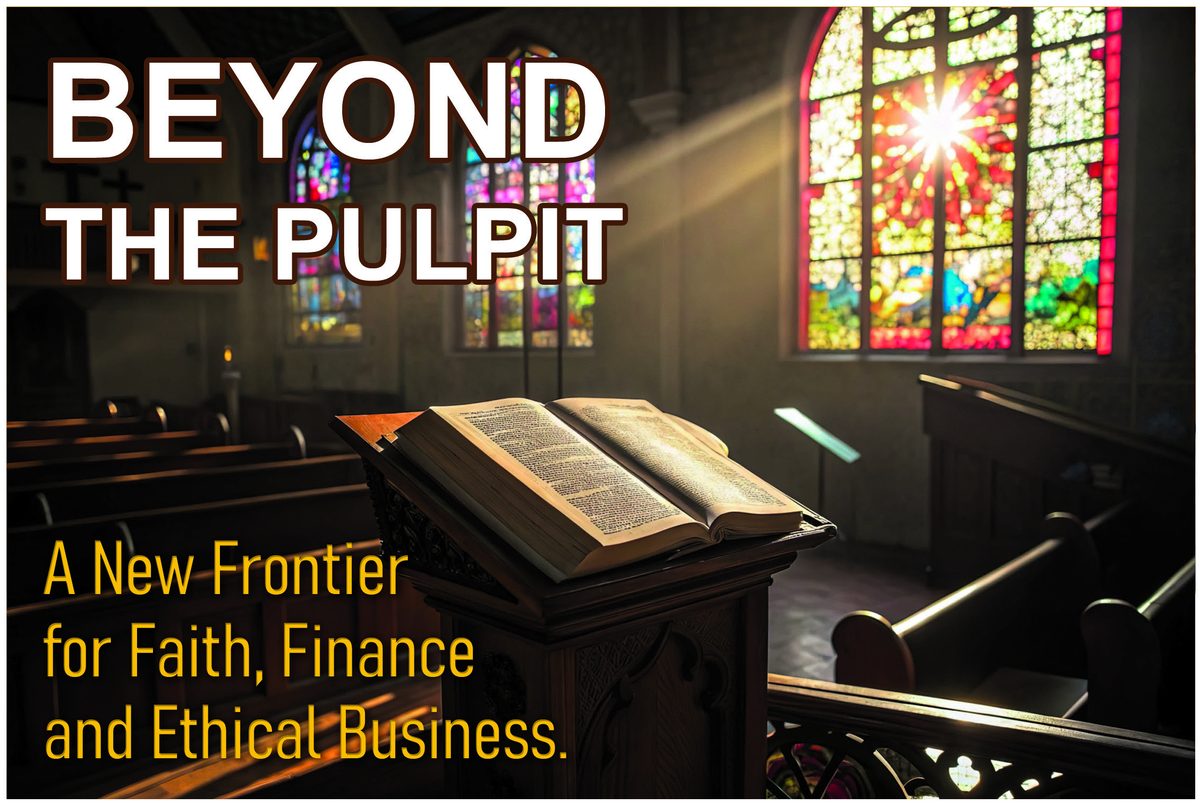
For a young woman entrepreneur, the start of a Monday morning in a small office is not just the begin of a workday — but also a time for prayer. Her spreadsheets help her track costs, revenue and investments. But she also regards her business as an opportunity to express her faith in God. For the young entrepreneur, work is not just a way to earn money: for her, it is a calling given to her by God.
Scenes like this are becoming pretty much the norm across the Christian world. For multiple generations many Christians have behaved as if there’s a line between Monday and Sunday and between the field of battle (the marketplace) and the sacred space of the sanctuary. Religion was for gospel, prayer and alms; finance, business, for the secular sphere.
That divide is starting to crumble today. More and more Christians are discovering a simple but powerful truth: the mission of faith does not stop when the marketplace opens. Rather, work, business, and all economic activity can be the places Christians see the heart of their faith demonstrated in a clear and responsible way. This developing vision is frequently referred to the movement toward an ethical enterprise.
Rediscovering Work as Vocation
The notion that faith can only be contained within the confines of a church is not deeply embedded in biblical teaching. Indeed, at the very beginning of Scripture, we are made to understand humans as caretakers of creation, expected to tend and nurture the world.
Genesis clearly describes what our job is: “The Lord God took the man and put him in the garden of Eden to work it and keep it” (Genesis 2:15). Work itself is, therefore, part of our divine mission.
Working professionals and service workers alike have a central role in the Bible. There are farmers, artisans, merchants, administrators, traders and more who serve in God’s people’s life throughout Scripture. The apostle Paul himself supported his missionary work by making tents (Acts 18:3), demonstrating that economic labor and spiritual service need not exist in opposition.
But this away did happen in current Christian life - pastors and missionaries assumed to be direct service of God, while businessmen and financial professionals were thought to work in a different realm.
The movement in the direction of ethical enterprise denounces it. It holds that every occupation, from teacher, to engineer, to farmer, to physician, to entrepreneur, can be a form of faith stewardship.
From Donation to Transformation
Throughout history, Christians have typically interacted with money through philanthropy. The finances of Christians were earned through the conjuration of their professions and then, a portion of the income was given back as a tithe and an offering to the church.
This tradition remains deeply important and continues to sustain churches, humanitarian organizations, and mission work around the world. But many Christian thinkers and entrepreneurs are asking a deeper question: Does God tell us only how to spend God-given money, or also how to earn it? This transition is a move away from donating to transforming.
In Ethical Enterprise, religious symbols don’t simply enter the market, they question whether the market has a moral responsibility. They don’t settle for marginalizing themselves from the business arena, they ask questions that touch the foundation of business:
Do we treat our workers with dignity? Are supply chains free of exploitation? Are wages fair and timely? Is the product/service genuinely useful for society?
These concerns echo strongly biblical teaching. The Hebrew Scriptures continue to call out justice in economic life: “You shall not oppress a hired worker who is poor and needy” (Deuteronomy 24:14–15). So does Proverbs say, “A false balance is an abomination to the Lord, but a just weight is his delight” (Proverbs 11:1).
Ethical business therefore demands that Christians consider not only how wealth is distributed, but also how it is created.
The Theology of the Spreadsheet
There are good reasons why finance has been met with suspicion in churches and on seminaries: Scripture repeatedly warns us about both greed and the corrupting influence of money. Paul says, the “love of money is a root of all kinds of evils” (1 Timothy 6:10).
But the Bible is also rich in instructions about stewardship, investments, and wise management of resources. Jesus’ parables are often steeped in economic metaphor. In the Parable of the Talents (Matt. 25:14-30) servants are given resources, and they have to be used rather than buried in fear.
Under the perspective of faith, profit is no longer the end of the economic life, but a support for responsible work and a means to serve others.
The wisdom literature in Scripture tells us how to manage our finances through patience and discipline. Proverbs says, “Wealth obtained in a haste we will lose, but whatever we gather little by little will increase”., Proverbs 13:11
The article discusses the idea that financial success is not an indicator of spiritual superiority or divine grace. Faithful stewardship rather than personal enrichment is the goal, which is beneficial to the entrepreneur and the community. This idea should be separated from prosperity theology and a clear line drawn between ethical enter prise and prosperity theology.
Social Responsibility and Impact Investing
In recent years, Christian entrepreneurs and investors have started paying attention to what has been called impact investing, a practice of investing capital in ventures that generate both financial returns and social impact. Rather than merely creating profit, such investment projects would focus on providing actual social needs, for example projects such as:
Affordable housing programmes Clean water initiatives Sustainable Agriculture Community development firms Ethical tech business.
Goal is often described as a “double bottom line”: Financially sustainable and coupled with a measurable social impact.
Trends in church entrepreneurship and can be observed in different parts of the world today. Christian organizations have set up microfinance missions in parts of Africa and Asia. Small entrepreneurs have been able to start businesses in regions where they were very hard pressed to find banks to serve their needs. Fair-trade cooperatives, often supported by church networks, have assisted farmers to obtain a fair price for their agricultural products and to strengthen local economies. These examples show that business can be used as a catalyst not only for profit but also for social revival.
Three Foundations of Ethical Enterprise
As this movement percolates, many Christian leaders have discerned three core principles that we can use to lead Christians in the marketplace.
1. Integrity: Integrity demands radical honesty and transparency in all decisions and economic transactions, from contracts to wages, to finance, etc. In a culture of heady corporate scandals, businesses built on a strong ethical foundation can provide a powerful witness.
2. Stewardship: Stewardship means that we acknowledge that all resources ultimately belong to God, and that God has entrusted these with us. Its emphasis is on long term thinking, not immediate profit-making. Responsible stewardship means sustainability, wise spending, and not playing quick game with others and with something that lasts.
3. Community: Businesses don’t exist in a vacuum. They build communities, create jobs, and help local economies thrive, while mentoring the next generation of leaders. Ethical enterprise is about creating enterprises that give empowerment, especially to those who are economically marginalized.
Acknowledging Structural Issues
Ethical entrepreneurs and capitalists both recognize that the current economic system is prone to structural barriers. These barriers include unequal access to capital, education, or markets, and economic inequality is still a worldwide issue.
Business participation by Christians therefore should go beyond personal integrity and include advocacy for justice in economic structures. A just economy includes fair wages, humane labor practices, and good governance.
The more expansive vision of ethical enterprise therefore assures that ethical enterprise is not only concerned with entrepreneurship, but also justice within economic systems.
Faith in the Ordinary Marketplace
What is the call to ethical enterprise? Your call to ethical enterprise is not a message for corporate executives or investors and high-level decision makers. It is a call to ordinary workers, freelancers, small business owners and consumers.
For some, being honest means cutting off the field of options available to them by refusing the profitable but dishonest practices available. For other people, it means starting a small business or providing employment in a depressed community. For all three, it means support ing business practices that are honest.
The apostle Paul brings this vision to life with a simple principle: “doing a good job in everything you do, as though you’re doing it for the Lord, not for people”. Colossians 3:23. In this way, the everyday work becomes the act of worship.
Beyond the Pulpit
A growing movement towards ethical enterprise signals a growing shift in the ways the Christian imagination engages with the world. Tradition no longer contains religion to services or private devotion. The conversation now includes economics, leadership, and innovation. The marketplace, once shunned or avoided, is now being rediscovered as a place where culture can be reached through Christian values of integrity, responsibility, and service.
When business practices demonstrate justice, stewardship, and compassion, they’re not just about economic win. They’re also, even if faint, some kind of marker of a new way of imagining society.
By stepping outside the pulpit, and finding ways to fold faith into finance, Christians are discovering new opportunities to participate in economic life that are consistent with their spiritual convictions. In so doing, each also becomes a part of shaping a marketplace that is one of stewardship, a place not only of competing interests, but of opportunity, serving, and hope.
Rev. Dr. Dola Vijay Kumar , a New Testament scholar, serves as Assistant Pastor at Santhosh Nagar Lutheran Church and is a former entrepreneur.