12A and 80G
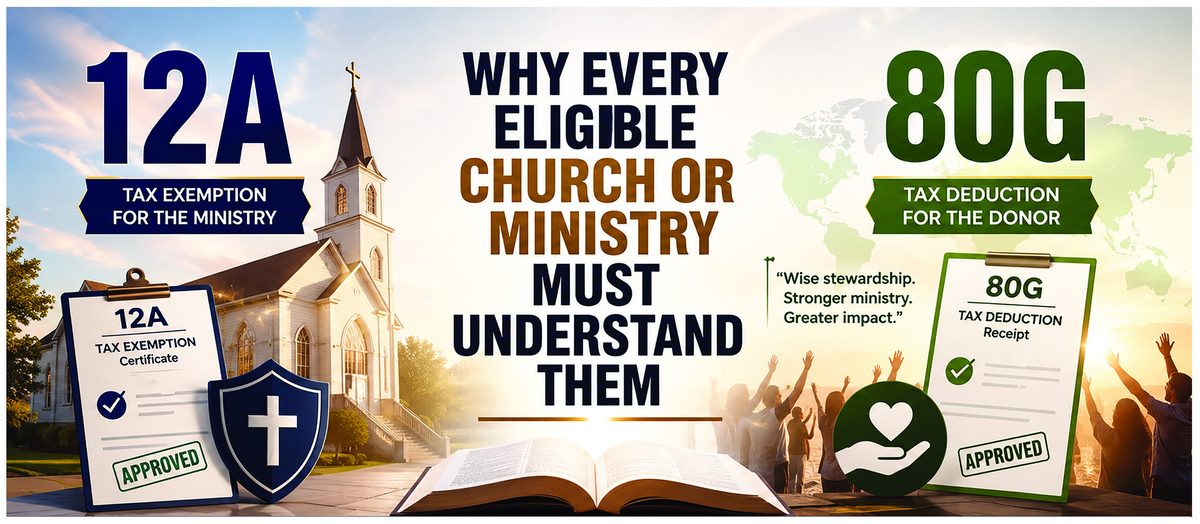
Churches and Christian ministries are established primarily to fulfil a spiritual calling—not to operate as commercial organisations. Yet every ministry that receives offerings, donations, grants, or other income also functions within a legal and financial framework.
Faithfulness in ministry, therefore, includes not only preaching, teaching, and serving people, but also administering the resources entrusted to the organisation with integrity, transparency, and accountability.
Two expressions frequently heard in this context are “12A” and “80G.” They are sometimes treated as interchangeable certificates or merely as documents required by donors. In reality, they serve different purposes, and misunderstanding them can expose a church or ministry to avoidable tax, compliance, and reputational risks.
A note on the new Income-tax law
From 1 April 2026, the Income-tax Act, 2025, has replaced the Income-tax Act, 1961, for tax years beginning on or after that date. Under the new law, the registration commonly known as 12A or 12AB registration is broadly continued under Section 332, while the approval commonly known as 80G approval is dealt with under Section 354, read with the donor-deduction provisions.
However, because pastors, ministry leaders, donors, and professionals are still familiar with the expressions “12A” and “80G,” those familiar terms are used in this article.
What is 12A registration?
A church or ministry may already be registered as a trust, society or Section 8 company. Such legal registration creates the organisation as a recognised entity. It does not, by itself, grant exemption from income tax.
The registration commonly called 12A enables an eligible public charitable or public religious organisation to claim the tax benefits available to registered non-profit organisations, subject to compliance with the law.
• Registration as a trust or society establishes the organisation.
• PAN identifies the organisation for tax purposes.
• 12A registration enables it to claim exemption under the prescribed non-profit tax framework.
Without the appropriate income-tax registration, offerings, donations, interest income, rent, grants, and other receipts may form part of taxable income unless another specific exemption is available. Even after registration, exemption is not automatic. The organisation must continue to satisfy the conditions attached to the registration.
Broadly, this means that the church or ministry should:
• carry out genuine activities according to its stated objects;
• use its income and property only for its religious or charitable purposes;
• avoid direct or indirect personal benefit to founders, trustees, pastors, office-bearers or their relatives, except legitimate and reasonable payments;
• maintain proper books, vouchers, bank records, and supporting documents;
• apply the required portion of its income—generally at least 85 per cent— for its approved purposes, or follow the prescribed procedure for lawful accumulation;
• file income-tax returns, audit reports, and other forms wherever applicable; and
• comply with other laws that are material to its activities.
Therefore, 12A registration should not be viewed as a certificate to be obtained and forgotten. It is an ongoing responsibility.
Can a church obtain 12A registration?
Yes. The law recognises public religious purposes as well as charitable purposes.
A church, prayer fellowship, mission organisation, or Christian ministry carrying on genuine public religious activities may be eligible to seek registration, provided its governing document and actual functioning satisfy the law.
However, the organisation must be public in character. A private religious arrangement established for the benefit of a particular family, closed group or selected individuals may not receive the same treatment as a genuine public religious institution.
The trust deed, memorandum, rules, or bye-laws should clearly establish that:
• its income and property cannot be distributed among members or trustees;
• its assets will remain dedicated to its stated purposes;
• no individual has ownership over ministry property; and
• on dissolution, the remaining assets will be transferred to another eligible non-profit organisation with similar objects.
The governing document should not merely contain standard clauses copied from another trust. It must accurately reflect what the church or ministry is actually doing.
What is 80G approval?
While 12A primarily concerns the tax position of the organisation, 80G primarily concerns the donor. When an eligible donor gives to an organisation holding a valid 80G approval, the donor may claim a deduction while computing taxable income, subject to the applicable percentage, limits, mode of payment, and other conditions.
For most donations to approved charitable institutions, the deduction is generally 50 per cent of the qualifying amount and may be subject to statutory limits. This does not mean that the donor receives 50 per cent of the donation back. It means that the eligible amount is deducted while computing the donor’s taxable income. The actual tax saving will depend on the donor’s income, tax regime and applicable tax rate.
Can every church obtain 80G approval?
No. This is one of the most important distinctions Christian leaders must understand. A church or ministry may be eligible for 12A registration because it carries on genuine public religious activities. But it does not automatically follow that the same organisation will qualify for 80G approval.
Under the law governing donor deductions, the institution must be established for charitable purposes, must not be expressed to be for the benefit of a particular religious community or caste, and its expenditure of a religious nature cannot exceed the prescribed limit—currently 5 per cent of its total income for the relevant tax year.
Therefore, an organisation whose principal purposes are church worship, evangelism, missionary work, pastoral ministry, discipleship, or propagation of the Christian faith will ordinarily face difficulty in obtaining 80G approval.
This does not mean that its activities are unlawful or unimportant. It simply means that the income-tax law treats an exemption for a public religious organisation differently from tax deductions available to donors.
Religious ministry and charitable service must not be confused
Grace Fellowship Church conducts worship services, prayer meetings, evangelism, discipleship programmes, and pastoral support. It may be eligible for registration as a public religious organisation. However, because its dominant purpose and expenditure are religious, it may not qualify for 80G approval.
Grace Community Care Foundation provides scholarships, medical assistance, disaster relief, livelihood support, and food assistance to the public without restricting benefits on the basis of religion. If its governing document, activities, accounts, and use of funds satisfy the legal requirements, it may be eligible for both income-tax registration and donor-deduction approval.
However, a ministry cannot become eligible for 80G merely by describing religious activities as “social service.” The tax authorities can examine the governing document, budgets, financial statements, photographs, reports, beneficiaries, publications, website, social-media content, and actual utilisation of funds.
Where a church conducts both religious ministry and substantial public-charitable activities, its legal and accounting structure should be professionally evaluated. A separate charitable organisation may sometimes be appropriate, but only where the separation is genuine and supported by distinct objects, governance, bank accounts, books, programmes, and decision-making. Artificial arrangements should be avoided.
Why 12A matters to the long- term credibility of a ministry
1. Protection of the ministry’s income: Valid registration enables an eligible organisation to claim tax exemption, provided it meets the continuing conditions. This allows resources to be used for the ministry’s stated purposes rather than being unnecessarily exposed to tax.
2. Better financial discipline: The process requires the ministry to clarify its objects, maintain records, document decisions, account for donations, and demonstrate how funds are used. These systems strengthen the organisation beyond tax compliance.
3. Institutional continuity: A ministry should not depend entirely on the personal reputation or control of one pastor, founder, or treasurer. Proper registration and governance help the organisation continue responsibly through leadership transitions.
4. Confidence among donors and ministry partners: Responsible donors increasingly ask for registration orders, audited financial statements, activity reports, and evidence of statutory compliance. They want assurance that funds are received in the organisation’s name, deposited into its bank account, and used for approved purposes.
5. Readiness for future opportunities: A small ministry may not require institutional funding today. But as it grows, it may seek support from foundations, churches, networks or other funding partners. Correct legal foundations established early are easier to maintain than hurried corrections made when a major opportunity arises.
Why 80G matters to donor confidence
80G approval can encourage eligible donors to support recognised charitable programmes because their donations may qualify for a tax deduction.
However, 80G should not be presented as a marketing label or a general government endorsement of every activity of the organisation.
A ministry holding approval must ensure that:
• the approval remains valid; • donation receipts correctly mention the approval details; • donor particulars are accurately collected; • donations are reported in the prescribed annual statement; • the prescribed donation certificate is issued to the donor; • the amount reported by the organisation matches the amount claimed by the donor; and • donations received for non-eligible or religious purposes are not incorrectly represented as eligible for deduction.
A cash donation exceeding Rs.2,000 does not qualify for donor deduction. Ministries should therefore encourage traceable banking modes and maintain a clear audit trail.
Under the current reporting system, approved organisations must report eligible donations and issue the prescribed certificates to donors. For tax year 2026–27 onward, the new forms are Form 113 and Form 114, replacing the familiar Form 10BD and Form 10BE framework.
Registration has an expiry date
Ministry leaders should never assume that 12A or 80G approval is permanent.
Regular registrations and approvals are generally granted for a specified period. Under the present framework, regular registration is ordinarily for five tax years. Qualifying smaller non-profit organisations may receive registration for ten years in specified renewal or conversion cases. Donor-deduction approval is ordinarily granted for five tax years.
Provisional registration or approval is generally granted for a shorter period.
The organisation should maintain a statutory calendar recording:
• registration number; • date of order; • period of validity; • renewal deadline; • authorised signatory; • return and audit deadlines; and • donation-reporting requirements.
Waiting until the certificate expires can lead to loss of exemption, donor disputes and difficult condonation proceedings.
A practical self-check for every church or ministry
The leadership should be able to answer the following questions:
1. Under what law is our church or ministry legally registered?
2. Do the legal name, PAN, bank account and financial statements all match?
3. Do we possess a valid income-tax registration order?
5. Are our present activities authorised by our trust deed or bye-laws?
6. Are offerings and donations deposited directly into the organisation’s bank account?
7. Are proper receipts issued and donor records maintained?
8. Are personal and ministry funds kept completely separate?
9. Are salaries, honorariums, reimbursements and related-party payments properly approved and documented?
10. Are income-tax returns and audit reports filed on time?
11. Are we claiming or advertising 80G benefits without valid approval?
12. Are our activities genuinely eligible for 80G, or are they predominantly religious?
13. Have amendments to our objects or governing document been properly approved and reported?
14. Can we clearly demonstrate how every major donation was used?
An inability to answer these questions should not be treated merely as an accountant’s problem. It is a governance matter for the pastor, trustees, governing body, and senior leadership.
Compliance is part of faithful stewardship
Some ministry leaders fear that legal structure may restrict spiritual work. Properly approached, the opposite is true. Clear governance protects the ministry from personal control. Proper accounts protect leaders from suspicion. Appropriate registration protects resources. Accurate donor reporting protects relationships. Timely compliance protects the organisation’s future.
The apostle Paul explained that financial administration should be conducted honourably, “not only in the sight of the Lord, but also in the sight of men” (2 Corinthians 8:21).
A ministry should never pursue 12A or 80G merely to collect more donations. Neither should it ignore these provisions because its work is spiritual. The correct approach is to understand the law, determine genuine eligibility, obtain the appropriate registration, and faithfully comply with its conditions.That is not merely good administration. It is responsible stewardship of the work God has entrusted to the organisation.
CA Vijay Ponneri, M.Com., CA, CPA is Director of EMET Global Strategies and has over 20 years of experience in finance, advisory, and teaching. He has a special burden to equip pastors, ministries, churches, and Christian leaders in the area of biblical stewardship and practical financial wisdom.